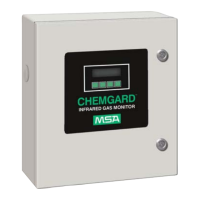
Chemgard Infrared Gas Monitor
RS485 connector labeled "+" on the
Monitor. Likewise, the connector labeled "-"
on the Relay Module must be connected to
the RS485 connector labeled "-" on the
Monitor.
6. Tighten each screw within connector to
secure each wire.
7. Pull on each wire to ensure that it will remain
in place. If a wire comes out of the
connector, loosen the screw, reinsert the
wire, and re-tighten the screw.
Relay Wiring
Before installing any wiring to the relays within
the Chemgard Relay Module, refer to the manual
for the specific equipment being connected to the
relays for wi
ring procedures and requirements. If
your unit is a four-point Chemgard model, use the
first four relays. The remaining four relays within
the bank are not used.
WARNING
Use the proper size wire to any equipment
connected to the Chemgard Relay Module
relay; otherwise, a fire or electrical damage
may result.
1. Refer to FIGURE B-2 for the relay wiring
entries into the Chemgard Relay Module.
2. Remove the hole plug(s) required and route
the relay wiring through the hole(s) using
proper hardware/conduit (not supplied).
3. Strip each relay wiring conductor.
4. Determine the relay functions necessary (see
front door label for relay locations and
contact information). Insert each stripped
relay wiring conductor into the connector
for the desired
function.
5. Tighten each screw within the connector to
secure each wire.
6. Pull on each wire to ensure that it will remain
in place. If a wire comes out of the
connector, loosen the screw, reinsert the
wire and re-tighten the screw.
7. Once wiring is complete, close and secure the
front panel of the Chemgard Relay Module.
CAUTION
Do not allow the front panel of the Chemgard
Relay Module to remain open during use.
Operation
Front Panel Indicators
(see FIGURE B-1).
Power Indicator
The power indicator shows that power is properly
applied to the unit.
•
If this indicator is not ON when power is
applied, refer to the Section 4,
Troubleshooting Guidelines.
Trouble Indicator
The Trouble Indicator turns ON and remains ON
when a trouble condition is detected. The trouble
condition may exist at the controlling Chemgard
Infrared Gas Monitor or it may exist locally at
the
Chemgard Relay Module.
Possible trouble conditions:
•
Chemgard Remote Relay Module losing
communication with the Chemgard Infrared
Gas Monitor for longer than two seconds
•
Monitor internal trouble
•
Relay Module inoperative relay.
See Section 4, Troubleshooting Guidelines for
other possible trouble conditions.
Ready Indicator
•
The Ready Indicator turns ON and stays ON
when the controlling Chemgard Infrared Gas
Monitor is ready and Relay Module is
operating properly
•
This indicator remains OFF during the
initial warm-up
•
This indicator remains OFF during the initial
Chemgard Inf
rared Gas Monitor warm-up,
setup and calibration.
Chemgard Relay Module Relays
There are three types of relays in the Chemgard
Relay Module:
•
common horn relay
•
common trouble relay
•
discrete alarm relays
The Common Horn Relay:
•
is a double-pole, double-throw (DPDT)
type relay
•
contacts are normally connected to equipment
to alert personnel of an alarm condition
The Trouble Relay:
•
is a double-pole, double-throw (DPDT)
type relay
•
is normally-energized during normal operation
for fail-safe operation


 To Next Page