Synthesis Engine
Synthesis Engine
88 89
Aer all phase modulation sources were weighted and added, their sum will be fed to
a tunable but static lowpass „Chirp“ filter. This can reduce aliasing eects or chaotic
noisiness, when phase modulation is used excessively.
The bipolar nature of many of the involved parameters further raises the complexity and
lowers the predictability of the system as a whole. The intricate feedback network can be
seen as a textbook definition of a „chaotic system“.
12
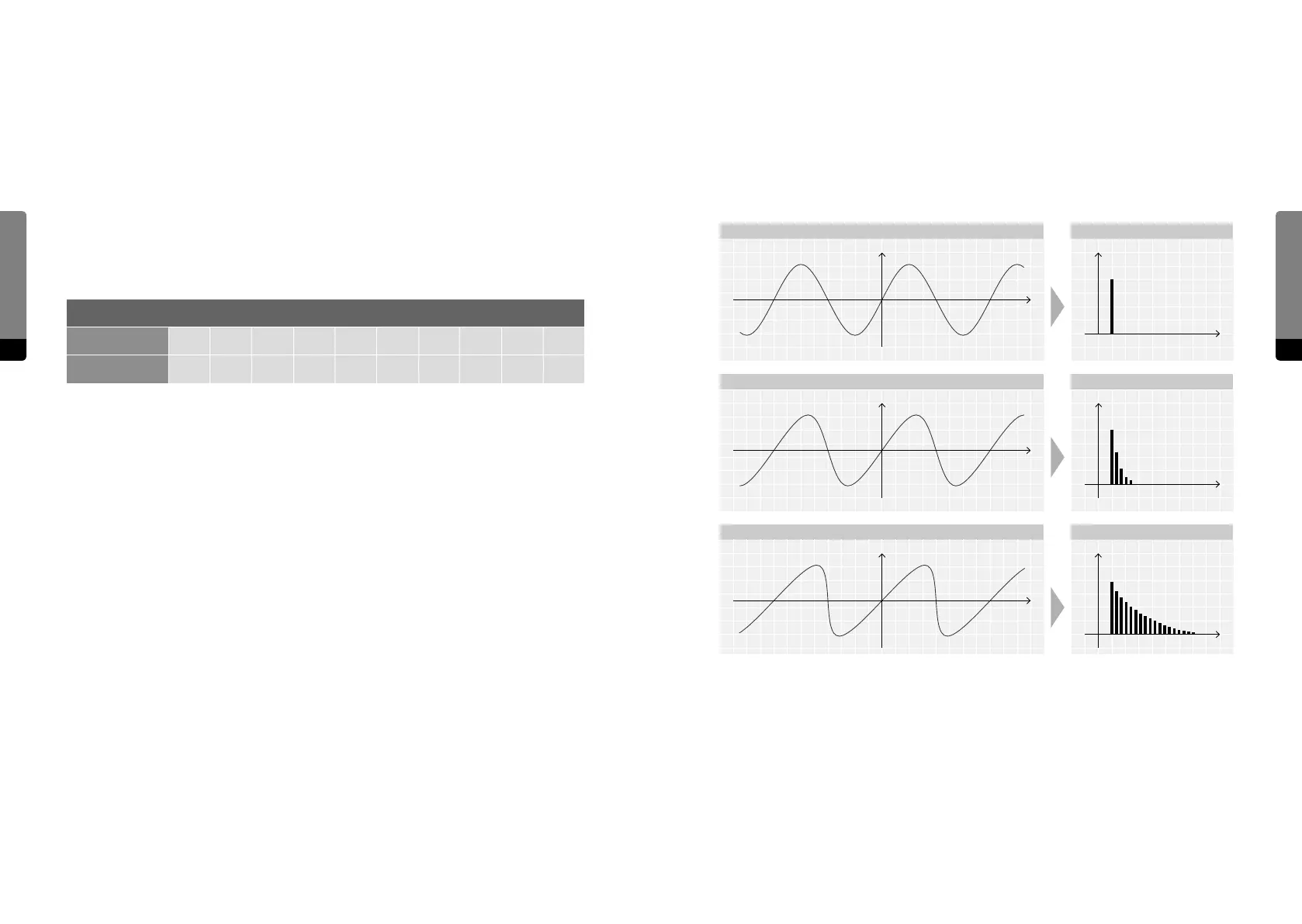
Curve Audio Spectrum
Hz
dB
y
x
Curve Audio Spectrum
Hz
dB
y
x
Curve Audio Spectrum
Hz
dB
y
x
Basically, if a slow „modulator“ signal modulates the phase of another fast and tonal „car-
rier“ signal, the perceived frequency of the fast signal will change over time, increasing or
decreasing the perceived pitch. The faster the modulator signal becomes, the faster the
frequency of the carrier signal will change. If both signals are periodical, new perceived
frequencies may emerge and others may disappear.
In general, strong and bright spectra can emerge. The produced sounds can be harmonic
and tonal (if the ratios of the Oscillator frequencies can be expressed by fractions of small
integer numbers) as well as noisy and atonal (like a metallic character, emerging from
non-harmonic partials). This strongly depends on relations that both involved oscillators
would have, like their frequency ratios and amounts of phase modulation.
Common Frequency Ratios
Dierence (ST)¹ 0 3.87 4.98 7.02 12 14.04 15.87 19.02 21.69 24
Ratio² 1/1 5/4 4/3 3/2 2/1 9/4 5/2 3/1 7/2 4/1
1 tuning dierence (in semitones) between Oscillator A and B
2 emerging Ratio
More specifically, three modulation sources can be used in parallel for each Oscillator.
Self modulation allows a particular oscillator to feed its own signal back, adding to its
phase. This leads to a saw-like appearance of the oscillator signal and a brighter sound,
depending on the modulation amount. The corresponding parameter is bipolar, aecting
the direction of the saw curve. The corresponding shaper signal can be crossfaded into
the modulation signal, further aecting the spectrum of the resulting oscillator signal. The
corresponding Envelope can also be applied on the amount.
The phase progression of a particular Oscillator can also be aected by the opposite
branch (and vice versa). Similar to self modulation, the amount can be set, the branch
shaper signal can be crossfaded and the branch envelope can shape the intensity. This
allows for complex intermodulations and elevates each Oscillator to function as both a
carrier and a modulator simultaneously.
The third phase modulation source is the global Feedback bus, being defined by the
Feedback Mixer. The amount can be defined and Envelope C can shape the intensity as
well. As the feedback signal can consist of polyphonic and monophonic parts, intermod-
ulations between several (parallel) voices can occur. In most cases, phase modulation by
feedback rapidly leads to noisy behavior.


 To Next Page