Synthesis Engine
Synthesis Engine
90 91
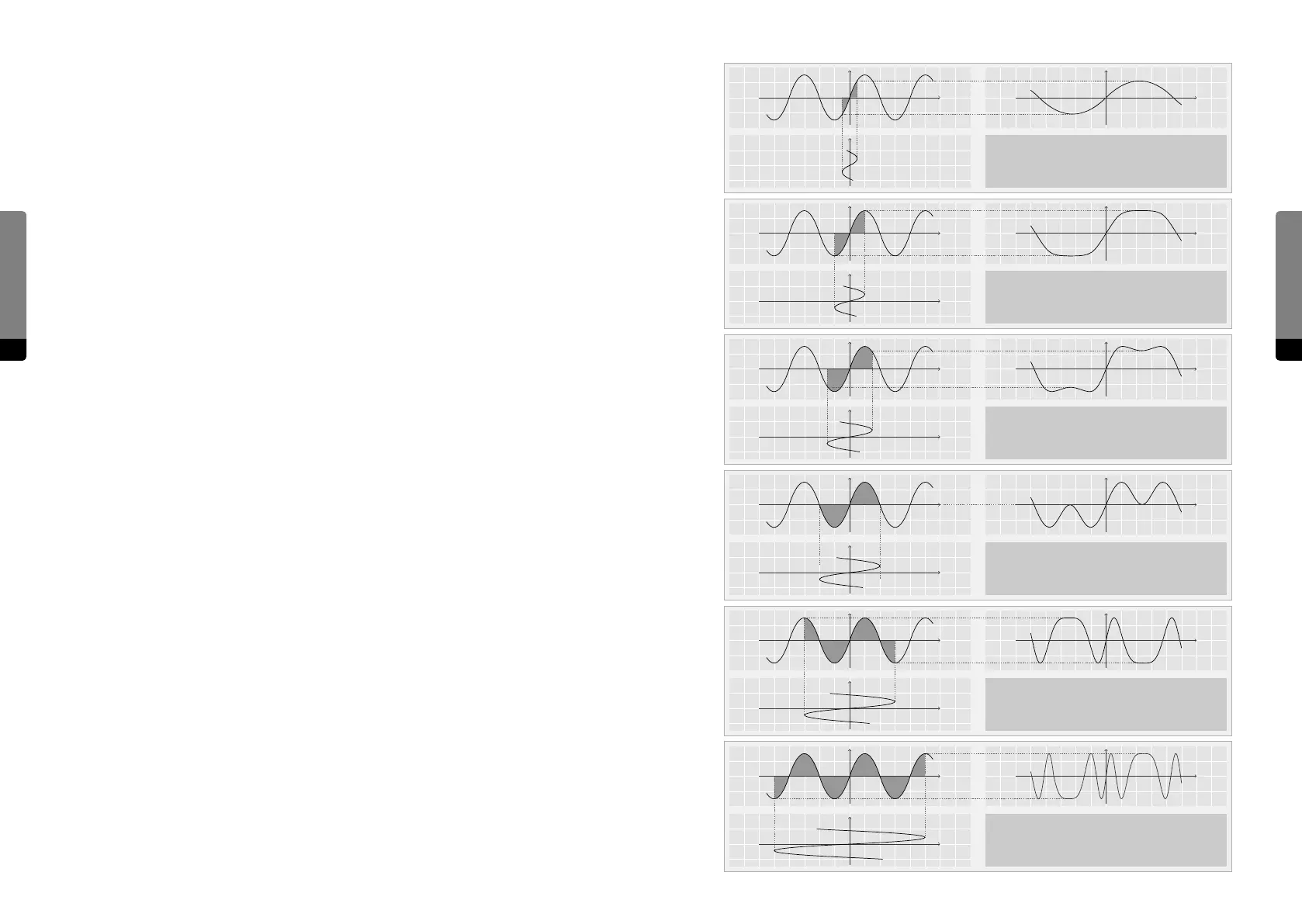
Drive: 0.0 dB
Fold: 100 %
Asymetry: 0 %
Drive: 3.0 dB
Fold: 100 %
Asymetry: 0 %
Drive: 6.0 dB
Fold: 100 %
Asymetry: 0 %
Drive: 9.0 dB
Fold: 100 %
Asymetry: 0 %
Drive: 12 .3 dB
Fold: 100 %
Asymetry: 0 %
Drive: 16 .8 dB
Fold: 100 %
Asymetry: 0 %
t
t
y
Input
x
t
t
y
x
t
t
y
x
t
t
y
x
t
t
y
x
t
t
y
x
Output
Input
Output
Input
Output
Input
Output
Input
Output
Input
Output
Shapers
Each of the two branches is completed by a sine shaper unit, which can further manipu-
late the oscillator signal and enhance its spectrum. It also allows for the integration of the
global feedback and a ring modulation signal.
The sine shaping mechanism can be compared to the computation of an oscillator signal,
which is derived from a continuously growing phase that is folded over and over again,
thus becoming periodical. From the periodical, wrapped phase signal, a sine approxima-
tion can be calculated.
Within a sine shaper, the input signal is first amplified by a Drive parameter, which can
be sensitive to the corresponding branch envelope. Aerwards, it will be interpreted as
a phase signal that will be folded. The resulting signal could be broadly described as the
„sine of a sine“.
Certain overtones will emerge in proportion to the Drive level. The folding characteristic
can be blended from a so clipping behavior by a Fold parameter. With no fold present,
the shaper eect resembles more a distortion or saturation eect, producing dierent
harmonics.
Furthermore, an Asymetry parameter can shi the fundamental frequency by one octave.
The resulting shaped signal can be crossfaded with the input signal by a bipolar Mix
amount (as previously mentioned, the bipolar nature of lots of signal components can
raise the complexity when using phase modulations or feedback).
Two more signals can be blended into the mix. The feedback signal can be fed into a
branch, the amount can be sensitive to Envelope C (blendable with the Gate signal).
With the application of feedback, the global Feedback loop will be closed to some extent
(depending on further settings).
Finally, the two branch signals are multiplied and each branch can blend to the „Ring
Modulation“ signal by a certain amount. Ring modulation produces interesting patterns in
the resulting spectrum, depending on the two incoming signals. Symmetrical frequency
components emerge (one with the dierence of the incoming frequencies, one with the
sum of the incoming frequencies).
Concludingly, the Shaper is another versatile module providing dierent ways to manip-
ulate an Oscillator signal. Distortion eects are as possible as sine shaping, and feedback
and ring modulation can be applied. The shaper not only aects the signal of a branch,
but can also be blended onto phase modulation sources for the oscillators.


 To Next Page