Synthesis Engine
Synthesis Engine
100 101
Output Mixer
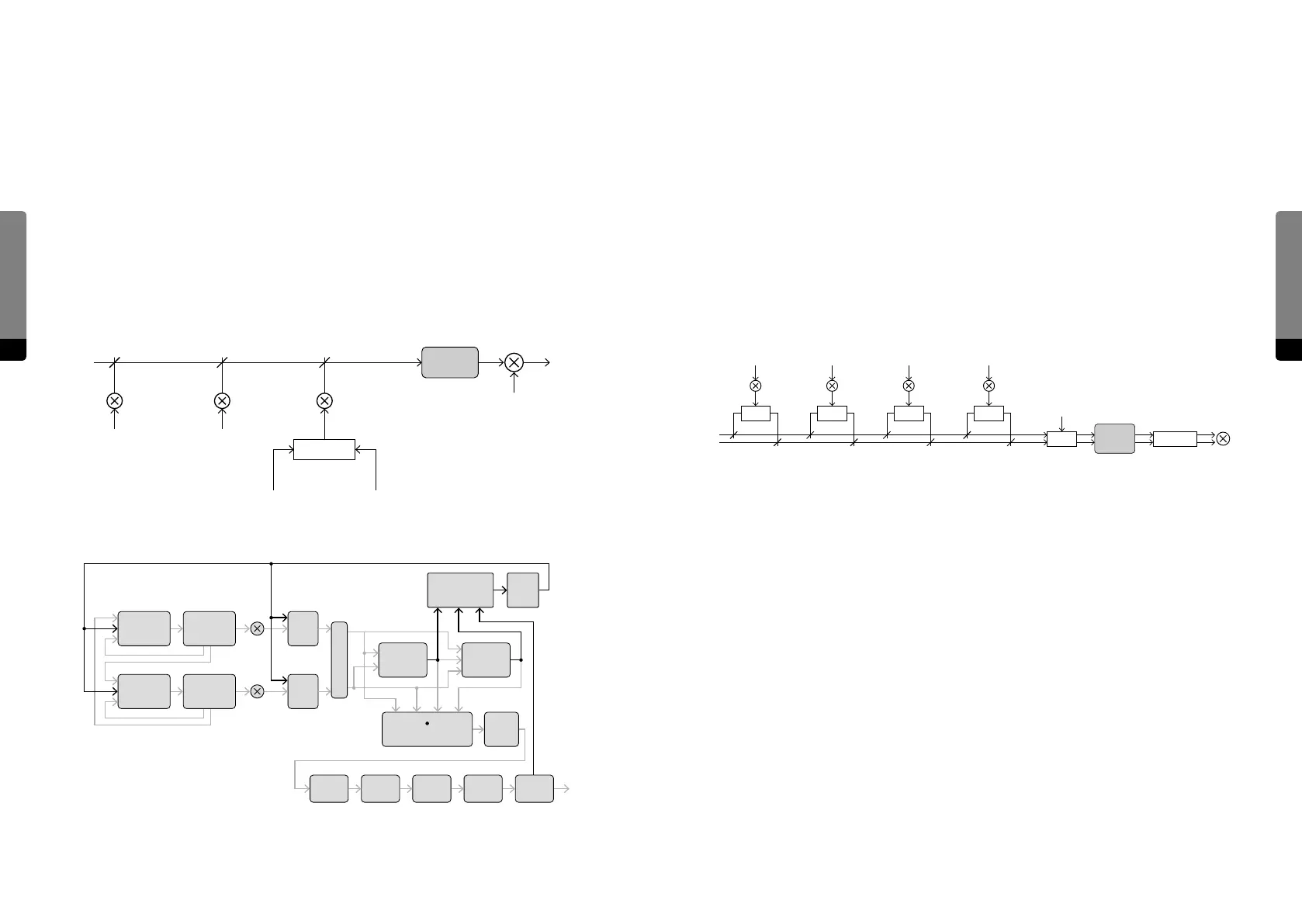
The (main) output signal, being passed to the Eects section, is defined by a stereo
mix of four signals provided by the two branches (A, B) and the two filters (Comb, SVF).
Each signal can be weighted by a bipolar amount and positioned in the stereo field by a
panning parameter.
A sine shaper (providing Drive, Fold and Asymetry, as described for the branch shapers)
can manipulate the sum signal and create additional harmonics. The sum also can be
amplified or damped by a Level parameter. The key position of a note can also be applied
for the tone’s position in the stereo field by a „Key Pan“ parameter.
Aer the output mixer, the signal will be monophonic (the sum of all voices) and at the
same time dual channel (with stereo spreading).
Eects
A chain of five stereo eects can be applied to the output signal, each eect having its
own characteristics and an individual mix amount, which blends it into the output mix.
Flanger
The first eect is a dynamic stereo delay capable of producing chorus-, phaser- or flanger-
like sounds. Its basic mechanism can be compared to the Comb Filter, although the
Flanger is not sensitive to Key Tracking. The usual sweeping eect arises when the delay
time is changing (due to modulations), as the delayed signal is combined with the input
signal and changing harmonics are created.
As the delay times are relatively short, this eect is not able to create wide spatial eects,
but a certain perception of depth will emerge nevertheless. The delay time can be spread
for both channels with a „Stereo“ parameter.
Pan
A B
Pan
Comb SVF
Level
Pan Pan
Pan Voice Mix
Shaper
Key Pos
Feedback Mixer
The global feedback signal, usable for phase modulation and within the Shapers,
is defined by a mix of four signals provided by the two filters and the Eects section
(blendable between pre and post Reverb). Each signal is weighted by a bipolar Amount
parameter, as the polarity can have a noticeable influence on the feedback behavior.
A sine shaper (providing Drive, Fold and Asymetry, as described for the branch Shapers)
can manipulate the sum signal and create additional harmonics. The sum also can be
amplified or damped by a Level parameter that can be sensitive to Key Tracking.
The feedback signal will be a mixture of polyphonic signals (provided by the filters) and
monophonic signals (provided by the eects, having no more voice association and being
a downmix of the original stereo signal).
Feedback Path:
Comb SVF Eects
KT
Reverb
Dry Wet
Shaper
Oscillator A Shaper A
FB Mix
FB Mix
Comb
Filter
Output Mixer (Stereo)
Feedback Mixer Shaper
Shaper
State
Variable
Filter
Oscillator B Shaper B
Cabinet
Gap
Filter
Flanger Echo Reverb
RM


 To Next Page