Synthesis Engine
Synthesis Engine
102 103
Cabinet
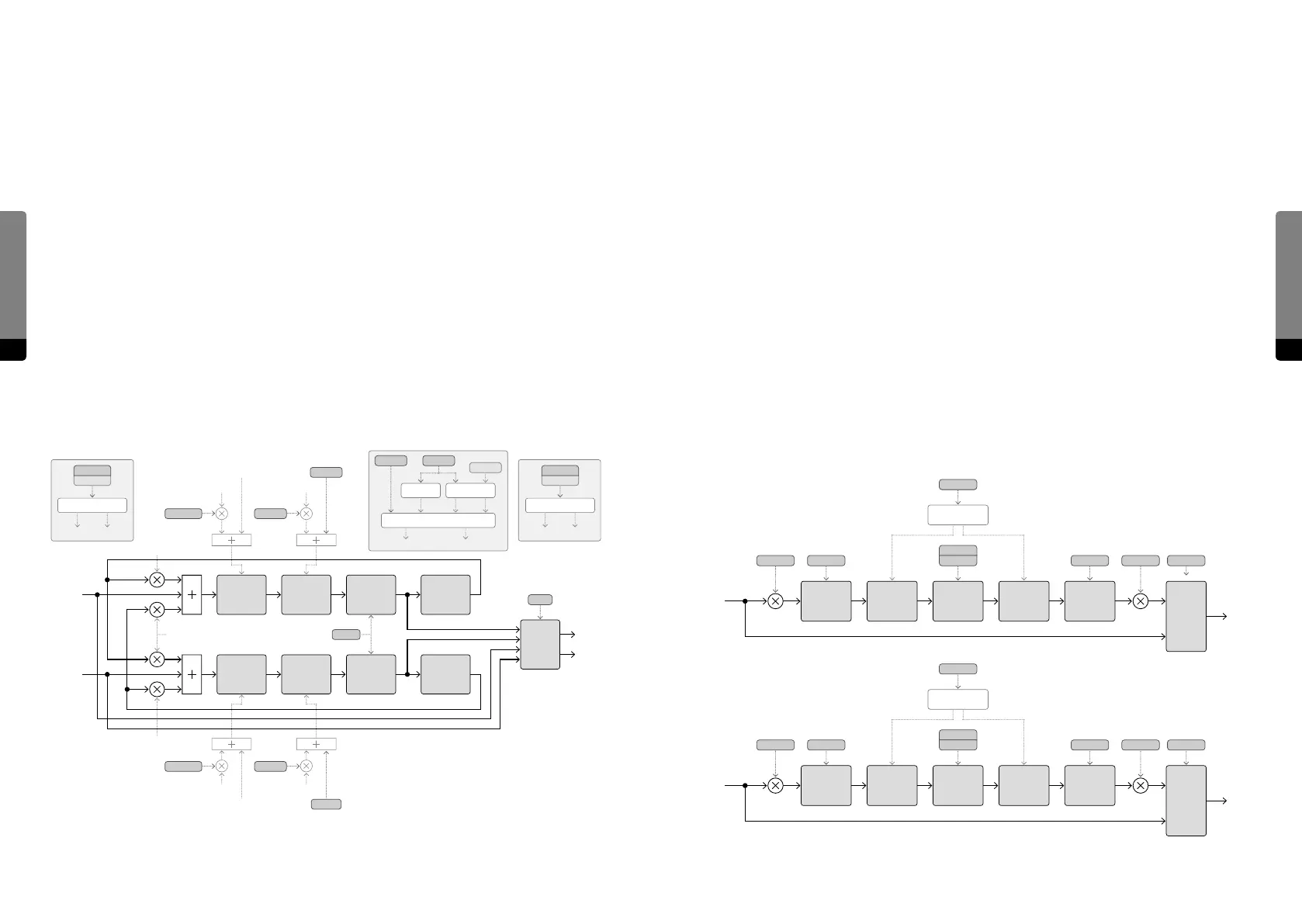
The second eect is called „Cabinet“, providing the possibility to further shape the
signal in terms of saturation, overdrive and distortion. It can be regarded as a basic amp
simulator.
A sine shaper (providing Drive, Fold and Asymetry, as described for the branch Shapers) is
the central element of this eect, allowing for the creation of new harmonics to the signal.
Before and aer the actual shaping, filtering is applied in order to further manipulate the
distortion eect. The signal passes through a highpass filter with adjustable frequency
(cutting low signal components) before being fed into the shaper. Aer the shaping, a
lowpass filter with adjustable frequency determines the amount of high signal compo-
nents (boosted by the distortion).
A Tilt parameter has a further influence on the signal spectrum before and aer the
shaping, as it can emphasize either low or high signal components that will be aected by
the shaper.
The shaped signal can be amplified by a separate „Cab Level“ parameter, before being
crossfaded with the input signal by the Mix parameter.
Drive Lo Cut Hi Cut Cab Lvl Mix
Tilt
Fold
Asym
Drive Lo Cut Hi Cut Cab Lvl Mix
Tilt
Fold
Asym
Pre Post
Pre Post
Tilt Control
Tilt Control
2-Pole
Highpass
Shaper
Shelving
Filter
X-Fade
Out L
In L
Shelving
Filter
4-Pole
Lowpass
2-Pole
Highpass
Shaper
Shelving
Filter
X-Fade
Out R
In R
Shelving
Filter
4-Pole
Lowpass
The local delay feedback bus consists of two filters, the first of which is an allpass filter
with a tunable frequency, aecting the phases of the signal’s frequency components. The
second filter is a one-pole lowpass filter with tunable frequency, damping the feedback
signal. The feedback level can be determined by an amount parameter and as this is a
stereo eect, cross feedback can be applied as well, feeding some amount of a signal
from one channel to the other (and vice versa).
Modulation sources for the Flanger are provided by a stereo LFO (with adjustable Rate
and stereo Phase oset) and a simple (monophonic) envelope signal (immediately
jumping to the velocity when a key is pressed and then exponentially approaching zero
within a time corresponding to the Rate parameter). A crossfade of the two sources
can be applied as modulation for the delay time and for the allpass filter frequency
independantly.
Finally, the Flanger signal can be blended into the mix by a bipolar Mix parameter, as the
signal polarity can have a strong eect when using the global feedback signal.
Time Mod AP Mod
Time Mod AP Mod
AP Tune
AP Tune
Env Rate
Mix
Hi Cut
FeedbackTime
FB X
Time L Time R
Mod LMod L
Time L
Mod RMod R
Time R
FB Self FB X
FB Self
FB Self
Mod L Mod R
Stereo Cross FB
Phase
LFOEnv
Feedback Control
X-Fade
Time Control
4-Pole
Allpass
Delay
X-Fade
Out L
Out R
In L
In R
50 Hz
Highpass
4-Pole
Allpass
Delay
1-Pole
Lowpass
1-Pole
Lowpass
50 Hz
Highpass


 To Next Page