Synthesis Engine
Synthesis Engine
106 107
Echo
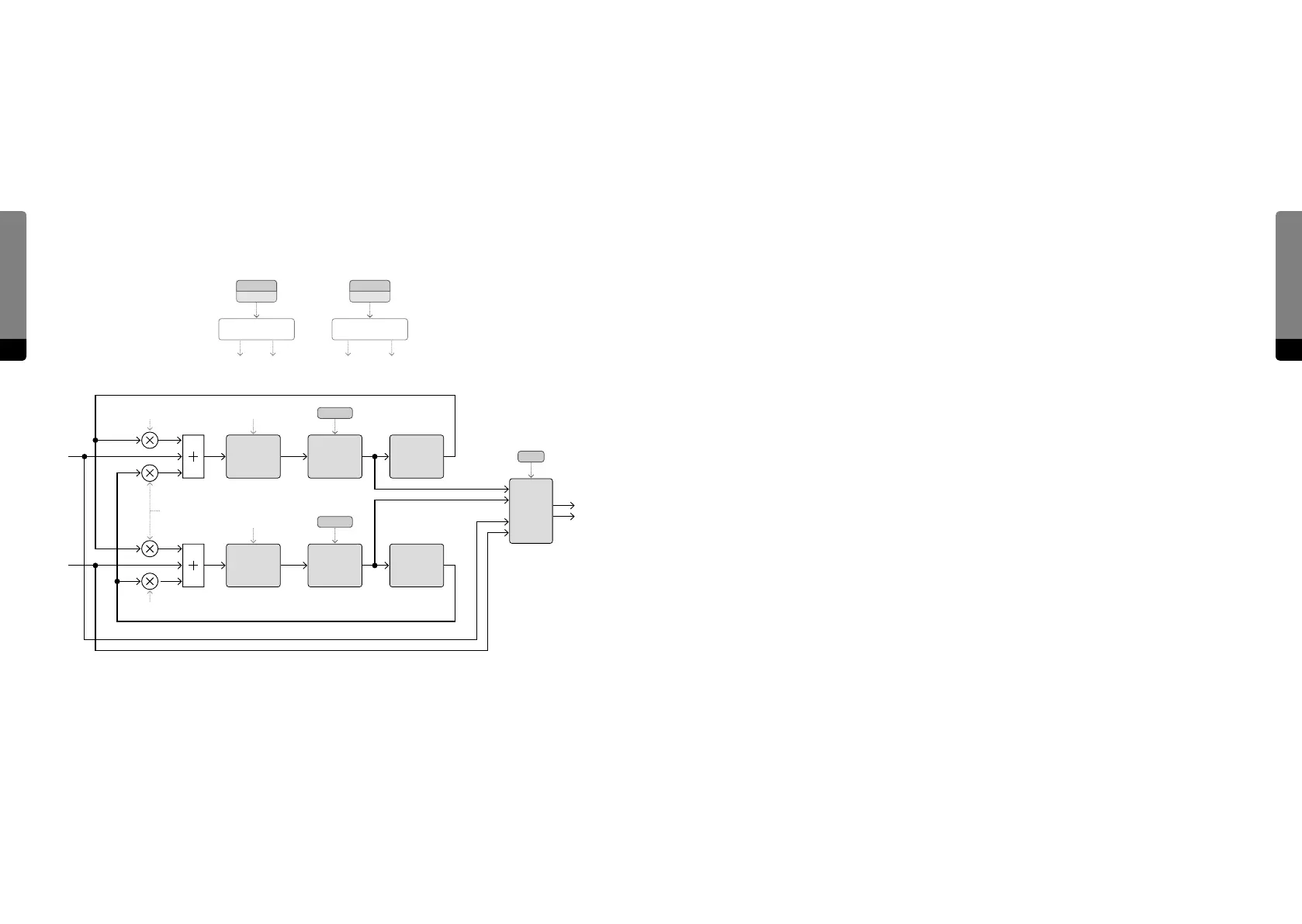
The fourth eect is a stereo delay, providing a spatial eect of repeating echoes. The delay
time can be adjusted and spreaded between the le and right channel. Within the local
feedback, a tunable lowpass filter allows for damping, and the feedback level can be
defined by an amount and a cross-feedback (feeding one channel back to the other and
vice versa). The echo can be blended into the mix by an adjustable amount parameter.
Hi Cut
Mix
Hi Cut
Time Feedback
Time L
Time R
Time L Time R FB Self FB X
FB Self
FB Self
FB X
Stereo Cross FB
Time Control Feedback Control
1-Pole
Lowpass
Delay
X-Fade
Out L
Out R
In L
In R
50 Hz
Highpass
1-Pole
Lowpass
Delay
50 Hz
Highpass
Reverb
Finally, the signal is passed to the Reverb unit, providing another spatial eect in terms of
hall, room or reverberation.
The Size parameter determines how long it takes for a signal to fade out, which has a pro-
found impact on the perceived room size. A Pre Delay parameter can also have a strong
influence in the size perception.
The local feedback behavior is determined by a Color parameter, aecting its brightness
and a Chorus parameter which can lead to a less static feedback behavior.
The Reverb signal can be blended into the mix by a separate amount parameter.
Post Processing
The resulting signal (a mixture of the Output Mix and the Eects section) can be ampli-
fied or attenuated by a Master Level parameter, before it passes through a so clipper,
preventing the signal from being clipped at the D/A converter.
Other Parameter Groups
Besides the Master Level, the Master group also contains a Master Tune parameter which
can shi the whole tuning of the instrument by up to 48 semitones in both directions.
The Scale group allows for redefining the scale of the instrument, which is the equal tem-
perament by default. The Base Key of a scale can be defined and all remaining 11 keys
can have an individual oset (up to 800.0 cents - eight semitones – in both directions) to
the equal temperament. So a variety of dierent scales is achievable, including historical
and traditional settings, pentatonic scalings or exotic and experimental types.
The Unison group provides additional control and allows for unison voices (more than
one sounding voice per pressed key). The number of unison voices can be adjusted (one
by default). Three spread parameters can determine, how each unison voice is spread
against the others: Detune can spread the pitches, Phase can spread the oscillator start
phases and Pan can spread the panning of individual unison voices.


 To Next Page