Parameter Reference
Parameter Reference
130 131
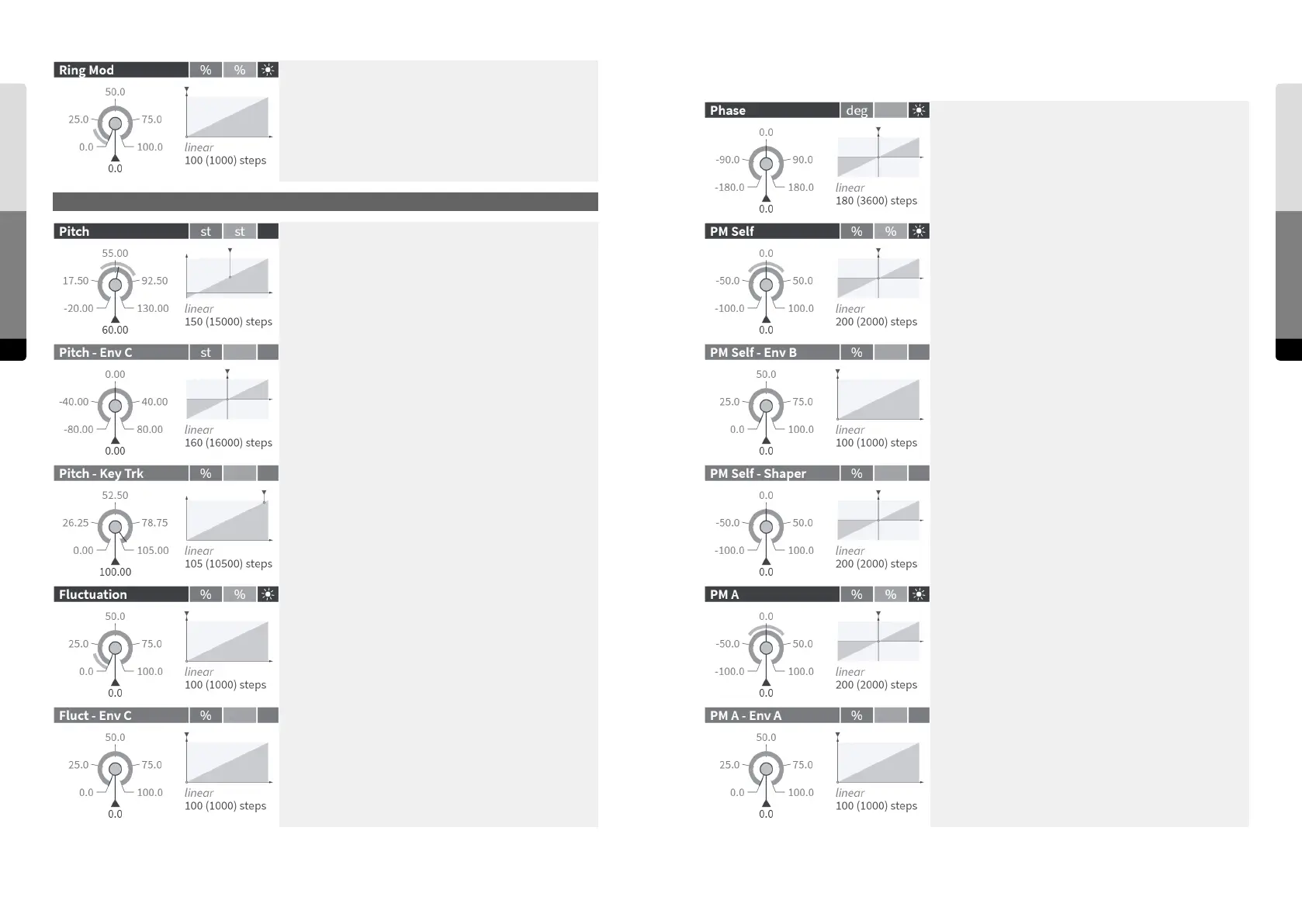
Start phase [in degrees]. The Oscillator will be set to this
phase position with each Note-On.
Amount of phase modulation by Oscillator & Shaper B (local
feedback).
Envelope (B) amount for the phase modulation by Oscillator
& Shaper B (local feedback).
At zero, the modulation stays constant, at higher values, the
envelope applies a time-variant attenuation.
Mix amount of Shaper B in the signal being used for phase
modulation (self). At zero, the output signal of Oscillator
B is used. At negative values, the signal from the Shaper is
inverted.
Amount of phase modulation by Oscillator & Shaper A (cross
feedback).
Envelope (A) amount for the phase modulation by Oscillator
& Shaper A (cross feedback).
At zero, the modulation stays constant, at higher values, the
envelope applies a time-variant attenuation.
Oscillator B
Mix amount of the ring modulation between both Oscillators
& Shapers.
Pitch (logarithmic frequency) of Oscillator B at C3 (MIDI note
60) [in semitones, based on MIDI note numbers].
The range below zero is shaped in the way that -20 corre-
sponds to 0 Hz.
Amount of pitch modulation by Envelope C [in semitones].
Key tracking of the oscillator pitch. It’s the scaling factor
between the key position (relative to C3 = 60 semitones) and
the pitch of the oscillator. At 100.0 %, the pitch follows the
equal-tempered scale. At values slightly larger than 100.0 %,
the tuning will be stretched. At 50.0 %, a quartertone scale
emerges and at 0.0 %, the pitch is constant for all keys.
Fluctuation of the oscillator frequency.
If the parameter is set larger than 0.0 %, the frequency is
changed at the beginning of each oscillation period by
a random amount. At 100.0 %, the maximum frequency
variation is +/- 95 %.
Amount of modulation of the frequency fluctuation by
Envelope C. At zero, the modulation stays constant, at higher
values, the envelope applies a time-variant attenuation.
Oscillator B
Oscillator B


 To Next Page