Parameter Reference
Parameter Reference
128 129
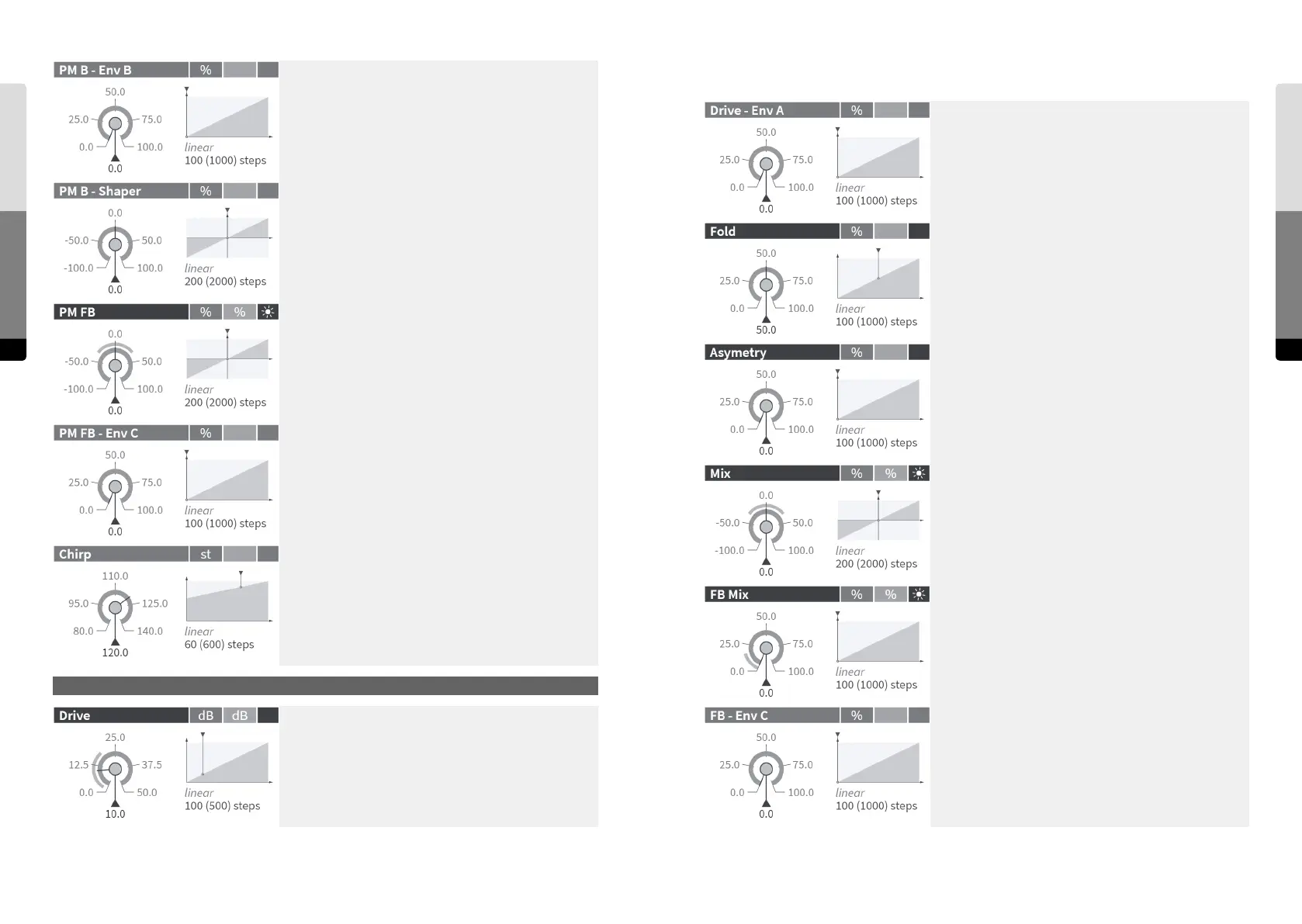
Envelope (A) amount for the Drive factor.
At zero, the gain stays constant, at higher values, the enve-
lope applies a time-variant attenuation.
Amount of folding back of the shaper curve for high input
amplitudes.
0.0 %: flat saturation, no folding
100 %: fully folded back (periodic sine curve)
A higher amount of folding leads to a soer but more nasal
sound.
Asymetry of the shaper curve, generating even (2nd, 4th, ...)
harmonics. At higher values it becomes a parabolic curve
that shis the frequency of the fundamental to its double.
Mix amount of Shaper A in the signal sent to the Filters
and to the Output Mixer. At zero, it is the input signal of the
Shaper - behind FB Mix. At negative values, the signal from
the Shaper is inverted.
Crossfades between Oscillator & Shaper A (at zero) and the
Feedback signal for the signal A.
Envelope (C) amount for the Feedback Mix. At zero, only a
Gate signal is applied, at higher values, Envelope C is faded
in.
Shaper A
Envelope (B) amount for the phase modulation by Oscillator
& Shaper B (cross feedback).
At zero, the modulation stays constant, at higher values, the
envelope applies a time-variant attenuation.
Mix amount of Shaper B in the signal being used for phase
modulation (B -> A). At zero, the output signal of Oscillator
B is used. At negative values, the signal from the Shaper is
inverted.
Amount of phase modulation by the Feedback signal.
Envelope (C) amount for the phase modulation by the
Feedback signal.
At zero, the modulation stays constant, at higher values, the
envelope applies a time-variant attenuation.
Cuto [in semitones] of the lowpass in the phase modulation
signal path that can be applied to reduce the level and
frequency of “chirping” appearing at higher amounts of self
modulation, cross-feedback through the other oscillator, or
global feedback.
Input gain [in dB] of the sine shaper stage. Higher gains will
create more distortion and harmonics.
Shaper A
Shaper A


 To Next Page