Parameter Reference
Parameter Reference
144 145
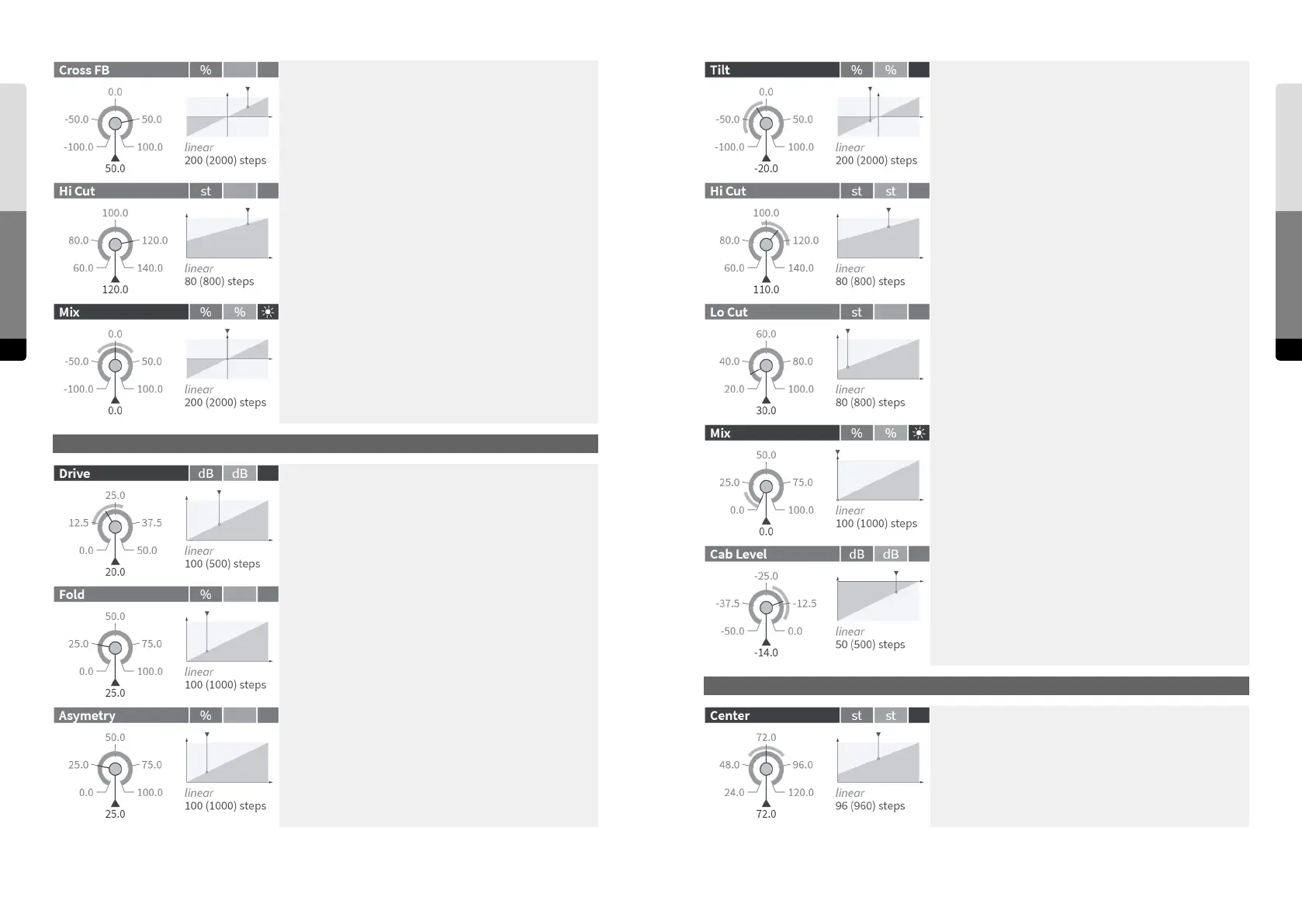
Controls two inverted shelving EQs before and aer the
distortion stage.
negative: more distortions at high frequencies
positive: more distortions at low frequencies
Cuto frequency [in semitones] of the lowpass filter at the
output.
Cuto frequency [in semitones] of the highpass filter at the
input.
Crossfades between the dry signal and the saturated signal.
Output level [in dB] of the saturation eect before it is mixed
with the dry signal.
Shis the mean cuto frequency of both 4-pole filters on
both channels up or down [in semitones].
Gap Filter
Gap Filter
Amount of the cross feedback between the le and the right
channel, increasing the complexity of the resulting signal.
At negative values, the cross feedback is inverted and will
emphasize other frequencies than in the non-inverted mode.
0.0 %: no cross feedback
+/- 100.0 %: all feedback is cross feedback
Cuto frequency [in semitones] of the filter that damps the
higher frequencies of the delayed signal.
Crossfades between the dry signal and the delayed signal. At
negative values, the delayed signal is inverted.
Gain [in dB] for the input signal. Higher gains will increase
the amount of distortion/saturation.
Amount of folding back of the shaper curve for high input
amplitudes.
0.0 %: flat saturation, no folding
100.0 %: fully folded back (periodic sine curve)
A higher amount of folding leads to a soer but more nasal
sound.
Asymetry of the shaper curve, generating even (2nd, 4th, ...)
harmonics. At higher values, it becomes a parabolic curve
that shis the frequency of the fundamental to its double.
Cabinet
Cabinet


 To Next Page