Chapter 3 OEM7 Receiver Operation
OEM7 Installation and Operation User Manual v1 50
To reset the PDP or GLIDE filter:
pdpfilter reset
To enable the PDP filter:
pdpfilter enable
Ensure the PDPFILTER command is used before the PDPMODE command. Set the PDP type
and kinematic type according to the application. For most kinematic applications:
pdpmode relative dynamic or pdpmode relative auto
The rest of the setup is position type and log dependent according to the application. For
example, details of the RTKSOURCE, PSRDIFFSOURCE, INTERFACEMODE, SERIALCONFIG
and other configuration commands are outlined in the OEM7 Commands and Logs Reference
Manual (OM-20000169). Also refer to the NovAtel application note APN-038 Pseudorange/Delta-
Phase (PDP) and GLIDE available from our web site (additional Application Notes available at
www.novatel.com/support/.
3.7 STEADYLINE
®
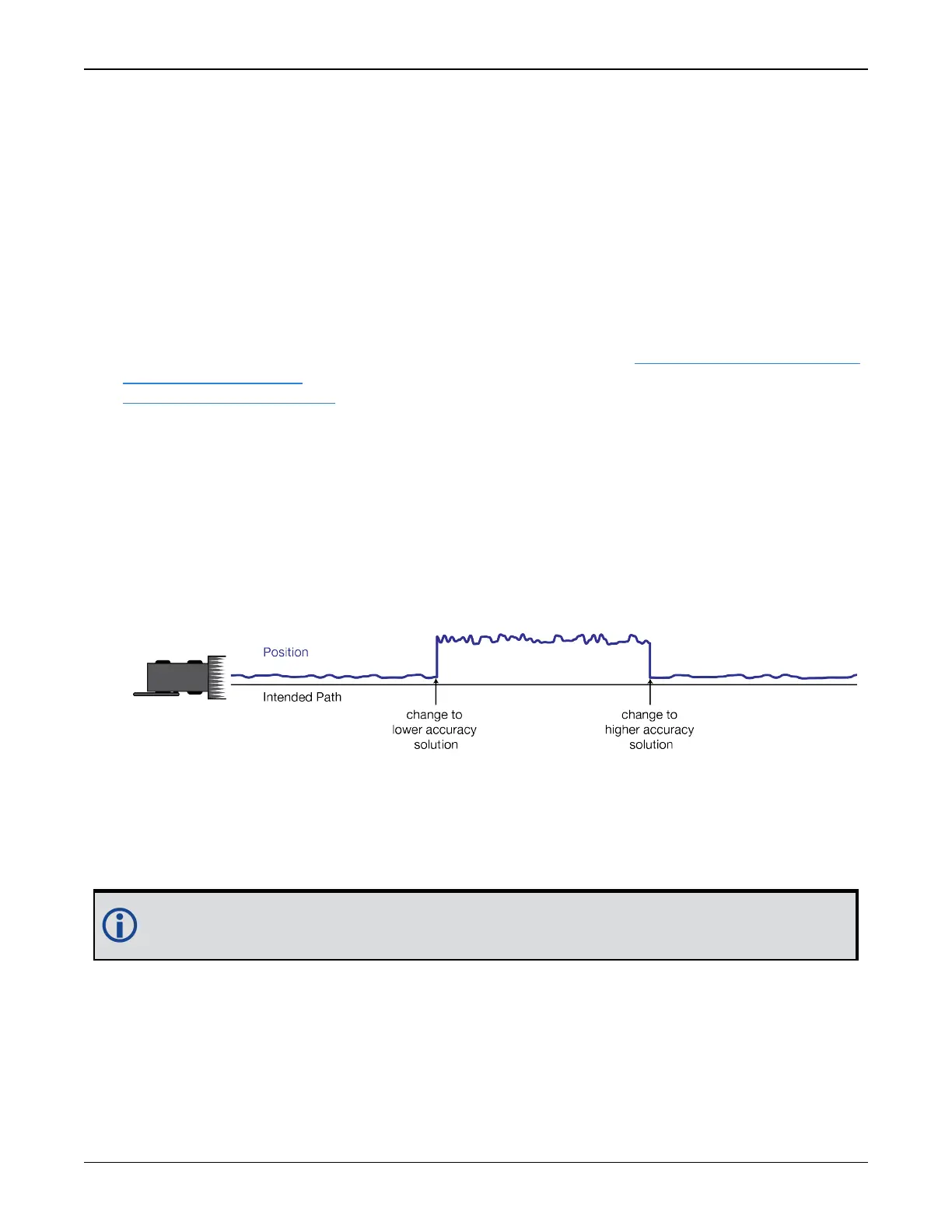
The STEADYLINE functionality helps mitigate the discontinuities that often occur when a GNSS
receiver changes positioning modes. The effect is especially evident when a receiver transitions
from an RTK position mode solution to a lower accuracy “fall back” solution, such as NovAtel
CORRECT PPP, DGPS, WAAS+GLIDE or even autonomous GLIDE (see Figure 16: Positioning
Change Without STEADYLINE below). Smooth transitions are particularly important for agri-
cultural steering applications where sudden jumps are problematic.
Figure 16: Positioning Change Without STEADYLINE
The STEADYLINE feature internally monitors the position offsets between all the positioning
modes present in the receiver. When the current positioning mode becomes unavailable, the
receiver transitions to the next most accurate positioning mode.
The setting in the STEADYLINE command determines how the receiver transitions to the next
positioning mode. The following sections describe the STEADYLINE modes.
For more information about the STEADYLINE command, refer to the OEM7 Commands
and Logs Reference Manual (OM-20000169).
3.7.1 Maintain
When the receiver transitions to a different positioning mode, it maintains the position offset cal-
culated to limit a potential real position jump. The receiver continues to apply the position offset
to all positions calculated in the new positioning mode.


 To Next Page