Chapter 4 Built-In Status Tests
OEM7 Installation and Operation User Manual v1 72
Refer to the RXSTATUS log, RXSTATUSEVENT log and STATUSCONFIG command in the
OEM7 Commands and Logs Reference Manual (OM-20000169) for more detailed descriptions of
these messages.
4.2 Error Strobe Signal
The error strobe signal is one of the I/O strobes. The strobe signal is driven low when the
receiver is operating normally. When the receiver is in the error state and tracking is disabled,
the error strobe is driven high. This can be caused by a fatal error or by an unusual receiver
status indication that the user has promoted to be treated like a fatal error. Once on, the error
status remains high until the cause of the error is corrected and the receiver is reset. For more
information about the error strobe signal, see OEM729 Strobe Specifications on page140 or
OEM7700 Strobe Specifications on page160.
An Error Strobe signal is not available on the OEM719.
When the receiver is in an error state, information about the error is provided in the RXSTATUS
log. See the OEM7 Commands and Logs Reference Manual (OM-20000169) for information about
this log
4.3 RXSTATUSEVENT Log
The RXSTATUSEVENT log is used to output event messages, as indicated in the RXSTATUS log.
On start up, the OEM7 family receiver is set to log the RXSTATUSEVENTA log ONNEW on all
ports. You can remove this message using the UNLOG command.
Refer to the RXSTATUSEVENT log in the OEM7 Commands and Logs Reference Manual (OM-
20000169) for a more detailed description of this log.
4.4 RXSTATUS Log
The Receiver Status log (RXSTATUS) provides system status and configuration information in a
series of hexadecimal words.
4.4.1 Status Word
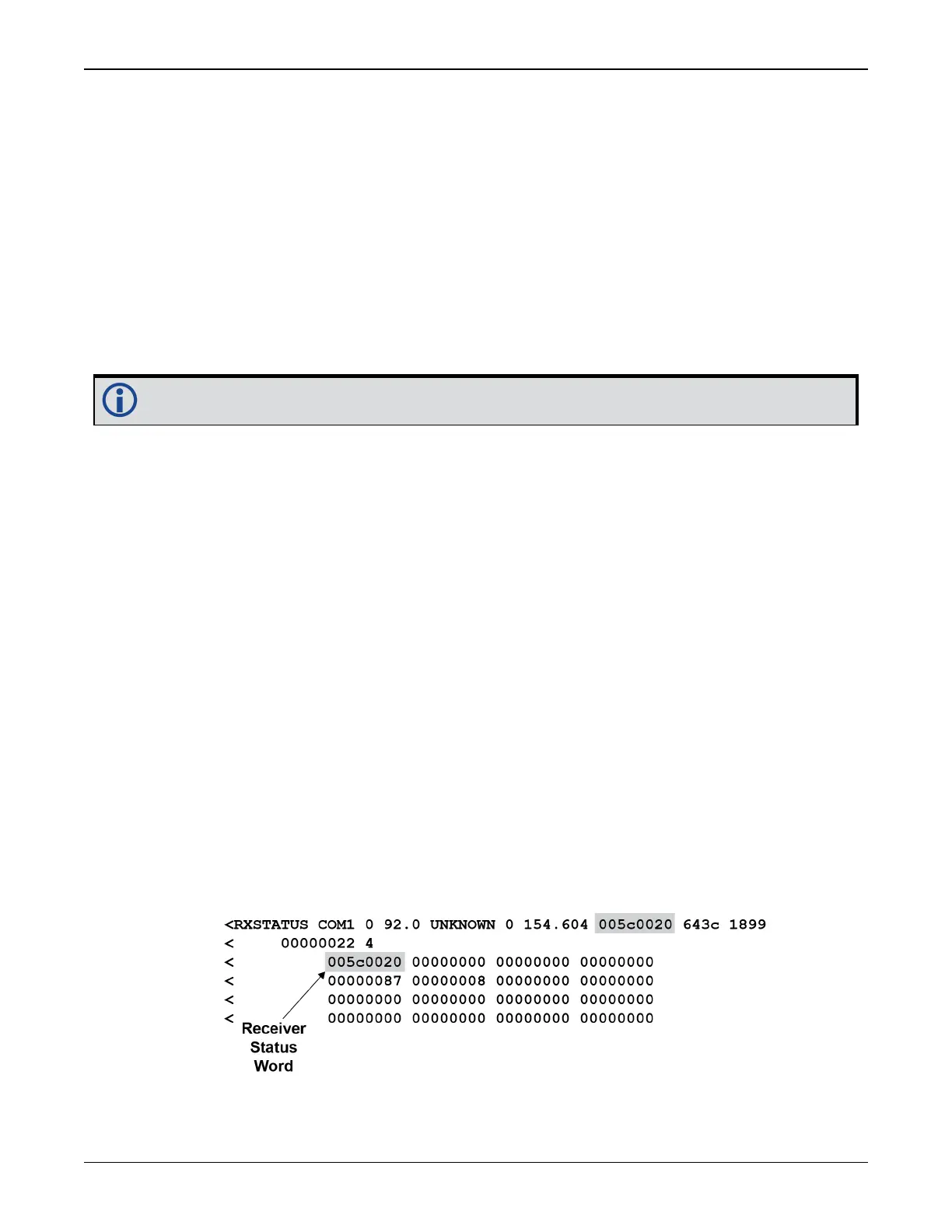
The status word is the third field after the header, as shown in the example in Figure 26: Loca-
tion of Receiver Status Word below.
Figure 26: Location of Receiver Status Word



 To Next Page