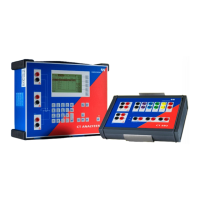
6.3 Functional description
The flexible hardware concept of Bode 100 allows to use it for several applications such as:
• Transmission / Reflection measurements
• Gain / Phase (transfer function) measurements
• Impedance measurements
The device operates in a wide frequency range from 1 Hz to 50 MHz. Bode 100 creates a sine-wave
at a frequency and measures two voltages. The creation of the sine wave and both voltage
measurements are synchronized such that magnitude and phase relation of the two measured
voltages can be derived.
From the magnitude and phase ratio of the two voltages, the Bode Analyzer Suite calculates
Impedance, Reflection, Admittance, Transmission or complex Gain values of the DUT (Device Under
Test).
For a complete list of all possible measurements that you can perform with Bode 100
see 8 Measurement types and applications on page 36.
6.4 Hardware revisions
Currently there are two mayor hardware revisions of Bode 100 available. Revision 1 and Revision 2.
To find out if you are using a Bode 100 R1 or a Bode 100 R2, check the identification plate on the
bottom of the device.
Below typical identification plates for a Bode 100 R1 and a Bode 100 R2 are shown.
Bode 100 R1 Bode 100 R2
If Option is Rev. 2, you are using a Bode 100 R2. If Option is empty, you are using a
Bode 100 R1.
Your identification plate might look slightly different due to different declaration logos or other
reasons.
18
OMICRON Lab



 To Next Page