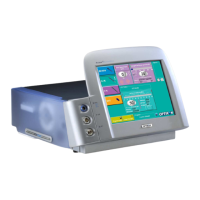
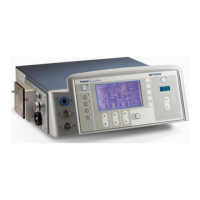
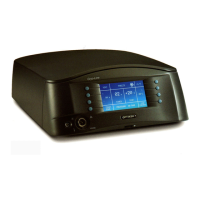
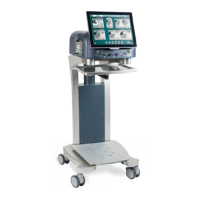
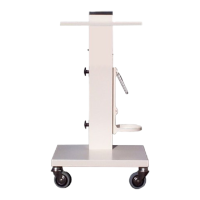
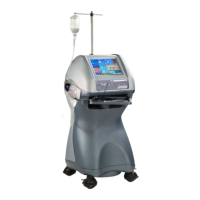
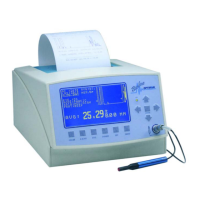
The PULSAR² ESP OPTIKON 2000 is an anterior segment surgery system designed for ophthalmic procedures, offering a combination of reliability, versatility, and advanced engineering. It features a sound engineering design and a user-friendly interface, making it suitable for a global market. The system is equipped with a Liquid Crystal Display (LCD) touch-screen, which serves as the primary interface for activating functions, setting parameters, reading values, and managing warnings and error messages. The software runs on a Windows CE platform, simulating various keys and displays.
Function Description:
The PULSAR² ESP supports several surgical modes:
- Irrigation/Aspiration (I/A): This mode manages fluid flow and intraocular pressure (IOP). It utilizes a unique dual pump system with Venturi and peristaltic pumps to ensure stable infusion and precise fluid control. The system automatically compensates for changes in infusion source height, and a safety vacuum sensor monitors the vacuum level in the aspiration line.
- Vitrectomy (VIT): This mode is designed for vitrectomy procedures, featuring a two-part cutter tip and blade, with the body containing the drive mechanism. The system provides precise control over cutting rates and aspiration, with adjustable parameters for vacuum level, flow rate, and rise time.
- Bipolar Diathermy (DIATH): This mode generates radiofrequency (RF) currents for heating tissues, causing coagulation. It offers both controlled and linear power modes, with adjustable power levels and a footswitch for activation.
- Phacoemulsification (PHACOEMULSIFICATION): This mode uses a piezoelectric U/S handpiece with a frequency of 40 KHz and tip strokes of up to 100µm. It features a piezoelectric ceramic element that converts electrical energy into mechanical vibration. The system offers various emission modes, including Short Pulse, Single Burst, Multi-Burst, Continuous Burst, and Programmable Emission Mode, allowing surgeons to customize the ultrasound pattern for different cataract hardnesses.
Important Technical Specifications:
- Manufacturer: OPTIKON 2000 S.p.a.
- Model: PULSAR²
- Regulatory Compliance: 93/42/EEC Medical Devices Directive (MDD)
- Electrical Specifications:
- Input voltage: 100/120/220/230-240 V A.C. (selectable)
- Frequency: 50/60 Hz
- Power consumption: 150 W
- Line fuses: 220/240 Volt: 2,5 A T; 100/120 Volt: 5 A T
- Compressed Air Specs:
- Input air pressure: 500-800 KPa (72 to 116 PSI)
- Air consumption: 30 normal litre/minute
- Irrigation:
- Fluid delivery: Gravity fed, eye pressure determined by height of irrigation source.
- Valving element: Solenoid driven pinch valve.
- Control: System footswitch.
- Aspiration:
- Aspiration pump types: Venturi and peristaltic.
- Actuating medium: Pressurized air from external source, pressure: 500+800 KPa (72÷116 PSI).
- Flow: At least 30 normal litre/minute @ 500mmHg.
- Default vacuum level: User programmable (5 to 500 mmHg).
- Default flow rate: User programmable (2 to 50cc/min for peristaltic only).
- Safety device: Vacuum sensor, monitors vacuum in aspiration line.
- VIT (Vitrectomy):
- Handpiece type: Pneumatically powered guillotine cutter.
- Cutting mode: Reciprocating motion.
- Default cut rate: User programmable (60 to 2500 cuts per minute).
- Port size: Adjustable from 0.2 to 0.7mm.
- Operating pressure: 230 KPa (34.0/-1.5 PSI).
- DIATH (Diathermy):
- Type: Bipolar generator.
- Operating frequency: 2 MHz.
- Nominal power: 7W (450 Ohm LOAD).
- No load max. voltage: 100 V.
- Available bipolar power: 5 to 100% (percent).
- Dimensions: Height: 33 cm, Width: 41 cm, Depth: 50 cm, Weight: 15 Kg.
- Equipment Classification: Class I electric shock, Type BF floating applied part (diathermy), Type B applied part (U/S).
- Degree of protection against harmful ingress of water (unit): IPX1.
- Degree of protection against harmful ingress of water (footswitch): IPX8.
Usage Features:
- User Interface: The LCD touch-screen allows for intuitive control and monitoring of all parameters. The system provides visual and audible feedback, including a speech synthesizer for announcements.
- Program Management: Users can create, store, and recall up to 100 programs, allowing for customized settings for different procedures or surgeons. Programs can be named using a virtual keyboard.
- Footswitch Control: An immersion-proof footswitch (IPX8) provides hands-free control over various modes. It can be programmed for single or double linear modes, activating irrigation, aspiration, diathermy, and vitrectomy functions.
- Safety Features: The system includes numerous safety features such as warnings and error messages displayed on the LCD, automatic aspiration halt if the I/A cassette is full, and checks for power mismatches. It also incorporates a safety vacuum sensor and a reflux valve to prevent sudden vacuum surges.
- Priming Procedure: A priming procedure ensures that the I/A lines are correctly installed, functioning, and filled with BSS solution before surgery.
- I.V. Pole Height Adjustment: The system allows for setting the I.V. pole height to maintain optimal intraocular pressure.
- Emergency Functions: In vitrectomy, diathermy, and scissors modes, a single touch can increase the intraocular pressure to maximum bottle height, useful for stopping intraoperative hemorrhage.
Maintenance Features:
- Cleaning: The touch-screen LCD can be cleaned with a soft cloth dampened with distilled water. The control console should be cleaned with neutral detergent.
- Sterilization: Reusable accessories must be first cleaned, then sterilized in an autoclave. Disposable accessories are provided in a sterile condition.
- Maintenance Checks: Periodical checks are recommended for the system's performance, including calibration and leakage tests. The manufacturer recommends contacting Optikon Distributor/Service Center for annual maintenance.
- Troubleshooting: The manual provides a comprehensive list of warning and error messages with corresponding corrective actions, aiding in quick problem resolution.
- Accessories: The system supports various accessories, including handpieces, cannulas, and I/A tubing sets. Proper handling and lubrication of O-rings are emphasized to prevent damage.
The PULSAR² ESP OPTIKON 2000 is a robust and versatile surgical system designed to provide precise control and safety for anterior segment ophthalmic procedures, backed by comprehensive maintenance guidelines.

 Need help?
 General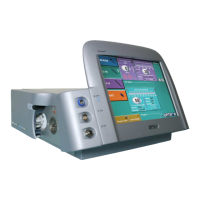

 To Next Page