Made in the U.S.A.
TROUBLESHOOTING
D A N G E R
C A U T I O N
C A U T I O N
Be extremely careful working
around unshielded sharp edges.
Injury may result from contact
with sharp edges.
153 - 045
TROUBLESHOOTING
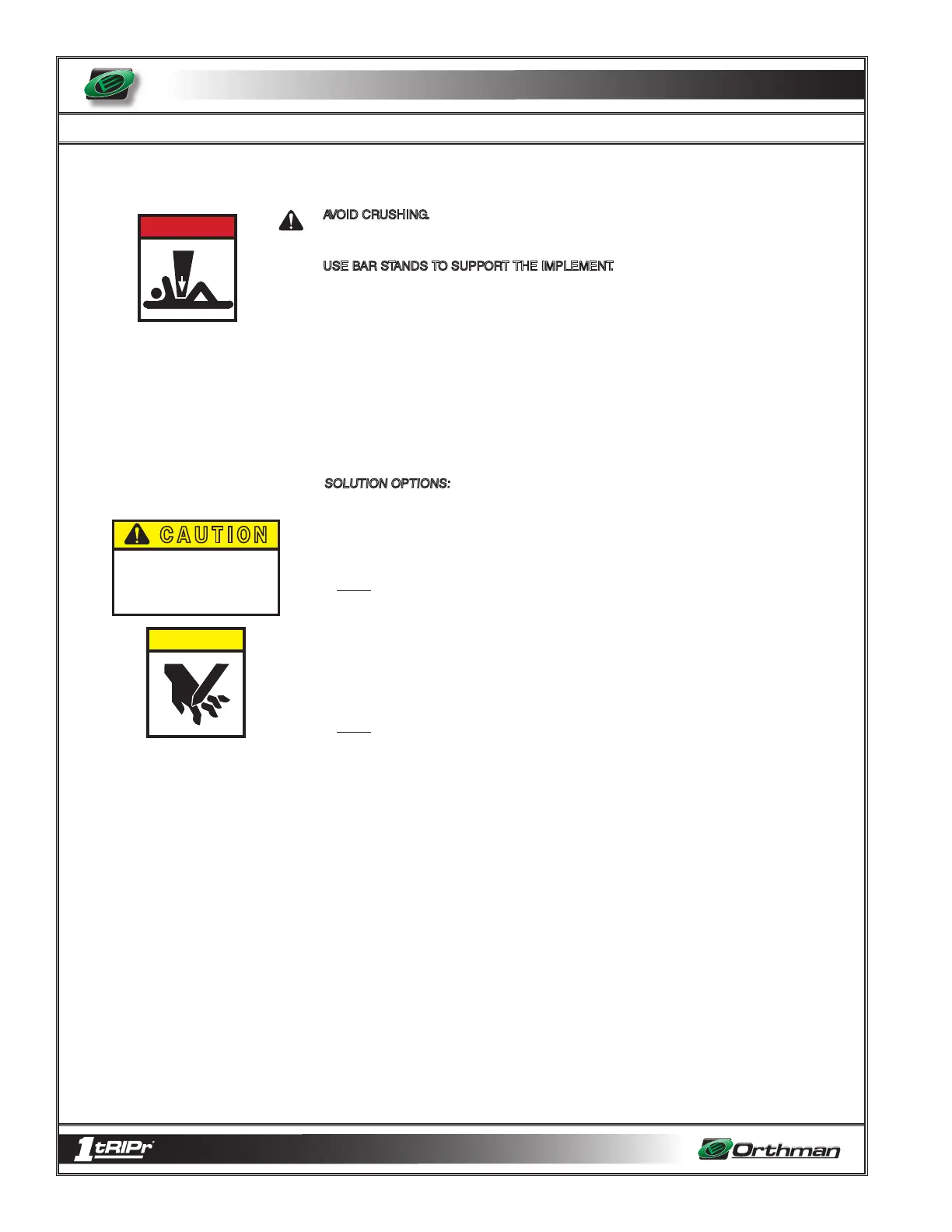
AVOID CRUSHING.
Make sure all personnel are clear of the implement. Lower implement
to the ground, place tractor in park, turn off engine, and remove key.
USE BAR STANDS TO SUPPORT THE IMPLEMENT.
Park implement on a clean, dry,
and level surface. An uneven surface could cause implement to shift or fall, resulting in
injury or death, as well as implement damage. Securely support all implement components
that must be raised. Remove buildup of grease, oil, or debris prior to adjusting rolling basket
down pressure.
PROBLEM:
Row unit plugs with field residue between the tillage shank and wavy coulters.
SOLUTION OPTIONS:
1. Slightly increase wavy coulter tillage width. Increasing tillage width should allow resi-
due to pass between the wavy coulters (pg. 5 - 8).
NOTE: It is not recommended for wavy coulter tillage width to exceed the width at
which trash openers remove residue. If wavy coulter tillage zone exceeds the residue
free strip, wavy coulters are more likely to plug as well as not penetrate soil.
2. Increase distance between tillage shank assembly and wavy coulter assemblies by
adjusting wavy coulter assemblies fore and aft (pg. 5 - 9).
NOTE: Increasing distance relationship between row unit tooling usually increases the
ability of field residue to pass through the row unit without plugging.
3. Alter ground speed to change rate at which field residue passes through row unit tool-
ing. Slower ground speeds generally reduce plugging by allowing residue to smoothly
pass through row unit tooling.
4. Wet or damp field conditions can adversely effect the performance of the 1tRIPr® row
unit. Typically, wet or damp field conditions do not allow residue to pass through the
row unit as effectively as drier conditions.
6 - 4


 To Next Page