Operator's Manual
Issue 14 / Mar 2016
MercuryiPS
©2016 Oxford Instruments NanoScience. All rights reserved.
Page 20
a touch-screen user interface
a motherboard PCB which contains the basic iPS functionality
a magnet current control board (power amplifier) which includes a switch heater output
an output filter board
a bank of heat-sink mounted power resistors with cooling fan and ducting
optional additional temperature sensor input(s) (on daughter boards)
optional auxiliary I/O (stepper motor drive and logic I/O)
optional GPIB (IEEE-488) interface.
2.6.1 Chassis
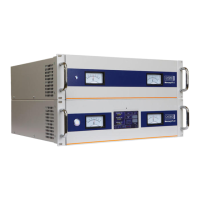
The iPS chassis is a rugged steel construct designed for standard 19” rack mounting. Each unit
is supplied with rack mounting brackets and handles as standard. There are 4 fans in the unit
to provide the cooling for the various high current devices. An inlet fan on the left side (viewed
from the front) provides a cooling air stream across the magnet control board. An exhaust fan
at the back of the unit extracts the heated air from the rear of the unit. A third high-power fan is
used to cool the large, finned aluminium heat-sink of the run-down power resistors. This fan
only cuts in when required, usually during a fast rundown of a large magnet.
2.6.2 Power Supply
This is an off-the-shelf 12V, 63A, 800W low-noise switch-mode power supply. It is universally
adaptable to all the common supply voltages and frequencies commonly found in all world
regions. Its output is controlled by the magnet control board to be as efficient as possible to
prevent unnecessary power dissipation inside the chassis.
2.6.3 User interface
The MercuryiPS contains a 4.3 inch full-colour, 480xRGBx272 pixel, liquid crystal display (LCD)
with a touch-screen overlay. The touch screen is a 4-wire resistive type and is the main input
device to the iPS. The functionality of the various GUI screens are described later in the
manual.
The front panel is also fitted with an ambient-light sensor. The iPS can be configured to change
the display brightness automatically to match ambient light conditions, for example if the unit is
to be used in an optics lab where low-light conditions are required.


 To Next Page