64 (E)
ENGLISH
Appendix (glossary)
Defined below are the terms used in this manual.
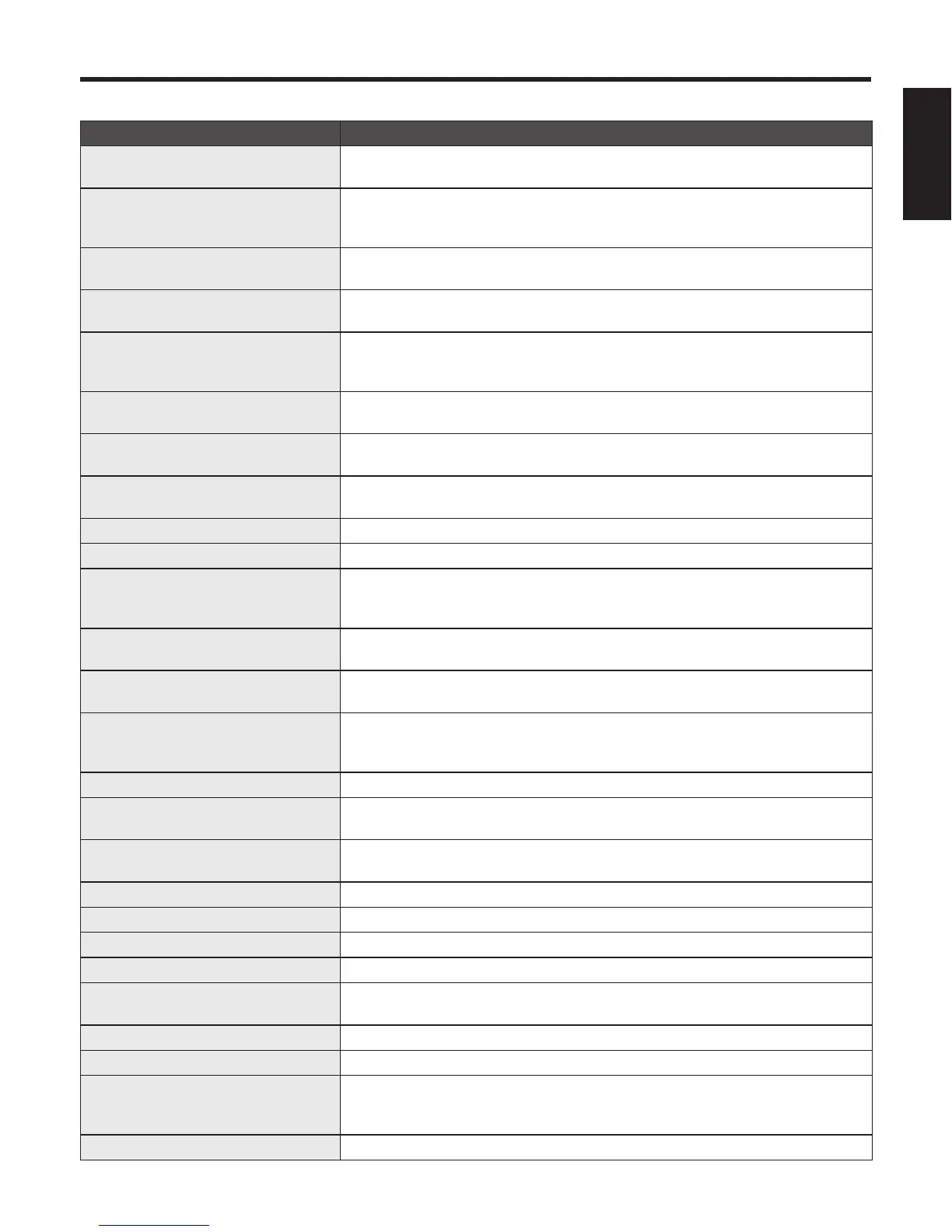
Word Explanation
AB Bus system A b
us control mode. By executing a transition, the A bus and B bus signals are
output to the programme images alternately.
Ancillary Data The auxiliary data other than the video signals which is transmitted inside the data
stream of the video serial interface. The data superimposed on the vertical blanking
period is referred to as the V ancillary data (VANC).
Aspect ratio The ratio between the horizontal and vertical dimensions of the screen.
It is 16:9 for the HD format and 4:3 for the SD format.
AUX [Auxiliary Bus] A spare bus which can be switched by signals other than the main line output
signals.
Border The area or margin that is added to the edge of a wipe or key.
Its width and colour can be adjusted. The defocusing of the area around a border is
referred to as the soft effect.
Chroma key This refers to the function for creating the key signals based on the colour
information of the video signals and combining the keys.
Clip The threshold level of the luminance when key signals are created from a key
source.
Colour Background The signals which are output from the internal colour generator and used as the
background image.
Cut This refers to the effect where the display is instantly switched to the next image.
Density A parameter which is used to adjust the density of the key signals.
Dot by Dot
This treats images as actual size (1) images. With PinP, it allows SD images to
be combined with HD images with no accompanying deterioration in the images
themselves.
DVI-D [Digital Visual Interface Digital] This is a video interface standard.
Only digital signals are handled by DVI-D.
Embedded Audio This refers to the audio data packets which are transferred inside the data stream of
the video serial interface.
Flip Flop system
(PGM/PST system)
A bus control mode. The signals selected by the programme bus are always output
as the programme images. By executing a transition, the programme bus and preset
bus signals are switched over.
Frame Memory A memory which can hold the video signals equivalent to one frame.
Frame Synchronizer A function which matches the synchronization of non-synchronized video input
signals.
Freeze A function which continues the display of the same image, creating the impression
that the image has been “frozen”.
FTB [Fade to Black] This is the effect where the programme image is faded out to the black screen.
GPI [General Purpose Interface] Interface signals which control auto transition from an external source.
Hue The colour tone of the video signals.
Key Edge The border or shadow added to the edges of keys.
Key Fill The signal that uses key combination processing to fill in the areas left blank by the
key signals.
Key Gain A parameter which is used to adjust the amplitude of the key signals.
Key Invert A function which inverts the key signals.
Key Mask This is the function that specifies the area for key combination using the box pattern,
etc. When only part of the area of the key signals is used, key combination is
executed with the unnecessary area masked.
Key Source The video signals for creating the key signals.






 To Next Page