Relion 1900e/2900e Manual
Revision 1.0 34
host memory domain from the remote host memory domain while enabling status and data exchange
between the two domains.
The PC
I express* Port 3A of Intel® Xeon® Processor E5-2600 v3, v4 Product Families can be configured to be
a transparent bridge or an NTB with x4/x8/x16 link width and Gen1/Gen2/Gen3 link speed. This NTB port
could be attached to another NTB port or PCI express* Root Port on another subsystem. NTB supports three
64bit BARs as configuration space or prefetchable memory windows that can access both 32bit and 64bit
address space through 64bit BARs.
The
re are 3 NTB supported configurations:
• NTB Port to NTB Port Based Connection (Back-to-Back)
• NTB Port to Root Port Based Connection – Symmetric Configuration. The NTB port on the first system
is connected to the root port of the second. The second system’s NTB port is connected to the root
port on the first system making this a fully symmetric configuration.
• NTB Port to Root Port Based Connection – Non-Symmetric Configuration. The root port on the first
system is connected to the NTB port of the second system. It is not necessary for the first system to
be an Intel® Xeon® Processor E5-2600 v3, v4 Product Families system.
Note: When NTB is enabled, Spread Spectrum Clocking (SSC) is required to be disabled at each NTB link.
Addit
ional NTB support information is available in the following Intel document: Intel® Server System BIOS
External Product Specification.
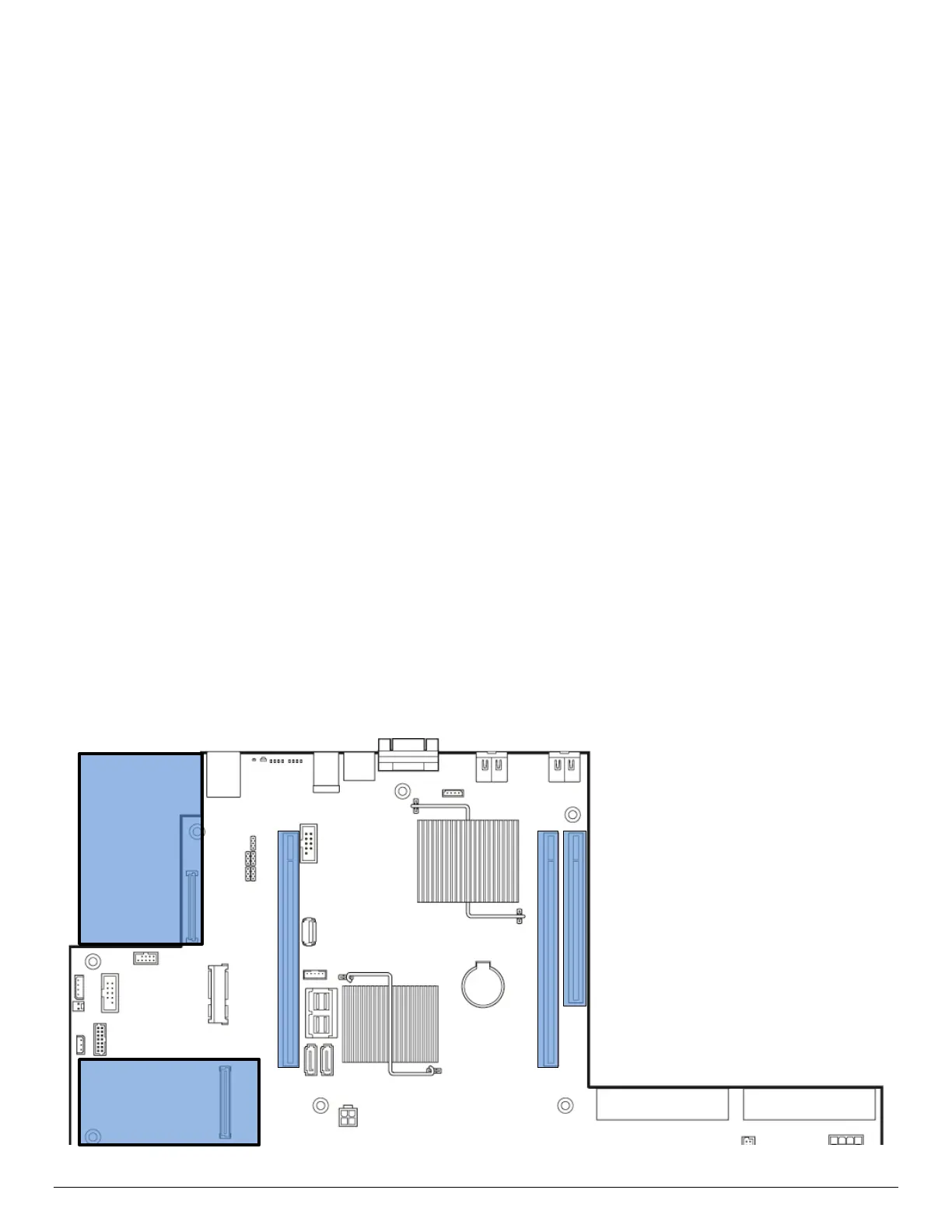
5.4 Add-in Card Support
The server board includes features for concurrent support of several add-in card types including: PCIe* add-
in cards via three riser card slots, Intel
®
I/O module options via a proprietary high density 80 pin connector,
and Intel
®
Integrated RAID Modules via a proprietary high density 80 pin connector. The following illustration
identifies the location of the onboard connector features and general board placement for add-in modules
and riser cards.
Intel
®
Integrated
SAS / RAID Module
Intel
®
I/O
Module


 To Next Page