VEHICLE RECOVERY AND SPRING BRAKES
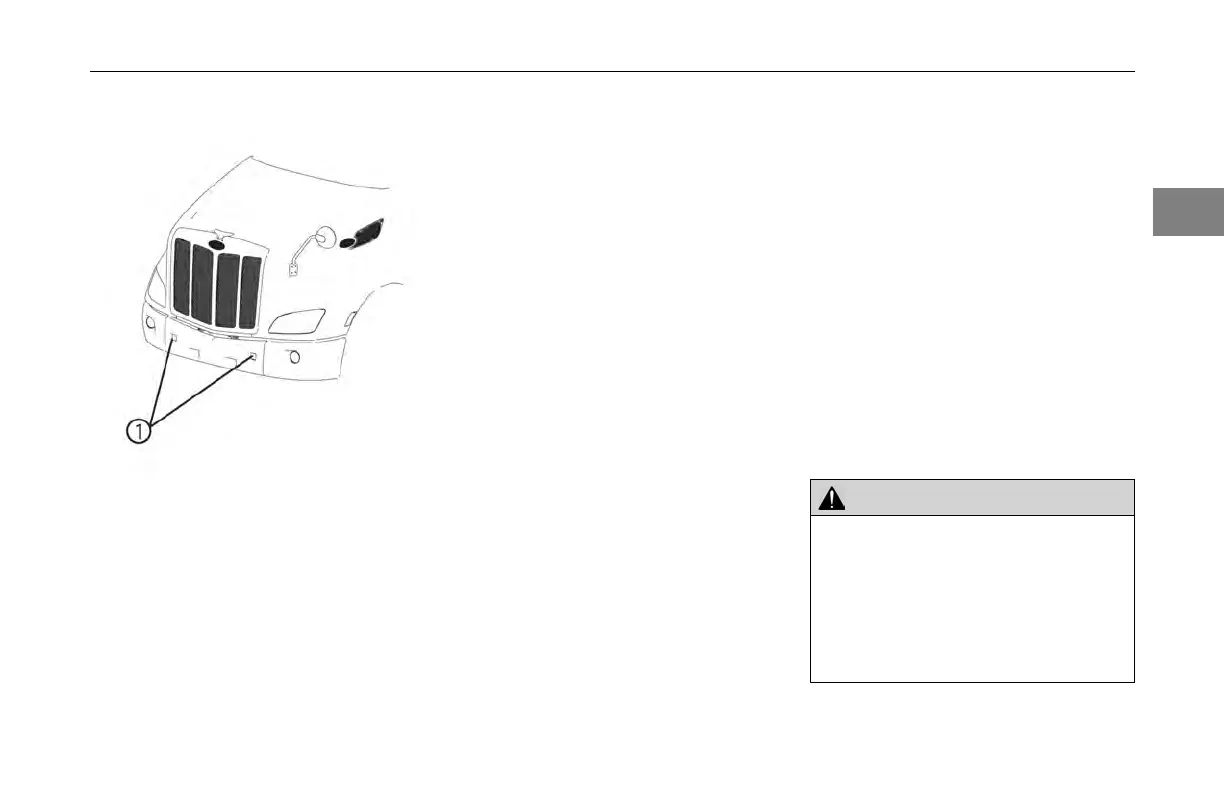
1 Recovery Hitch Sockets
Recovery Procedure
1. Review and
understand all the
cautions and warnings of this
section, see
Vehicle Recovery
Guidelines on
page 2-12.
2. Install the
recovery hitches, see
Recovery Hitch
Installation on
page 2-
15.
3. Disconnect the
drive axle shafts
and cover the open hubs. This
is necessary because if the
transmission is driven by the
driveshaft (rear wheels on the
ground), no lubricant will reach
the gears and bearings, causing
damage to the transmission.
4. Install the
recovery rigging using a
safety chain
system, see Recovery
Rigging on
page 2-19.
5. Make sure
the recovered vehicle's
parking brakes are released.
6. If you
desire to use the recovered
vehicle’s brakes, ensure that
the vehicle’s
air system is
connected to that of the recovery
vehicle. Ensure that any air line
that has been removed from a
driver-controlled main differential
lock is rmly capped to prevent
loss of air pressure from the
recovery vehicle if it is supplying
air pressure.
If you don’t desire to use the
recovered vehicle’s brakes,
ensure that you cage the spring
brakes before attempting to move
the vehicle,
see Driver Controlled
Main Differential
Lock on page
2-16.
WARNING!
Before towing a vehicle, test your air
brakes to ensure that you have prop
-
erly connected and inspected the re-
covery vehicle’s brake system. Failure
to do so could lead to a loss of vehicle
control which may result in an accident
involving death or personal injury.
2
(04/13) Y53-6047–2C 2-13



 To Next Page