17
Laboratory Oscillator 1
Overview
The sounds created by the Laboratory Oscillator 1 are the culmination of
years of research and design. The unique wave shaping circuitry we
have created is the foundation of our analog sound.
The unique sound of the Voltage Lab 2 starts with a refined version of our
temperature stabilized, analog VCA saw wave oscillator core. The
internal signal path of the Laboratory Oscillator 1 passes the core saw
waveform through up to 8 wave shapers before reaching the output.
The selected waveforms’ name should be thought of as more of a
guide to harmonic density than the definitive shape of the output wave.
During the design phase, we began calling the initial clean geometric
waveforms (sine, triangle, saw, square) seed waves because the
shapes of the waveforms available at the output are very different than
the internal source wave. As an example, if all the wave shaping is
turned down, the output of the triangle wave looks more like a sine
wave than the output of the sine wave on an oscilloscope. Because of
the intensive wave shaping, the seed wave is simply one of several
factors that determine the shape and sound of the output.
The internal signal path of the Primary Oscillator is more complex than
most oscillators. All of the wave shapers before the wavefolder
circuit are designed to manipulate the waveform in ways that allow it to
interact with the wavefolder in interesting ways. Let’s take a close look
at each stage of the signal path in the order they occur.
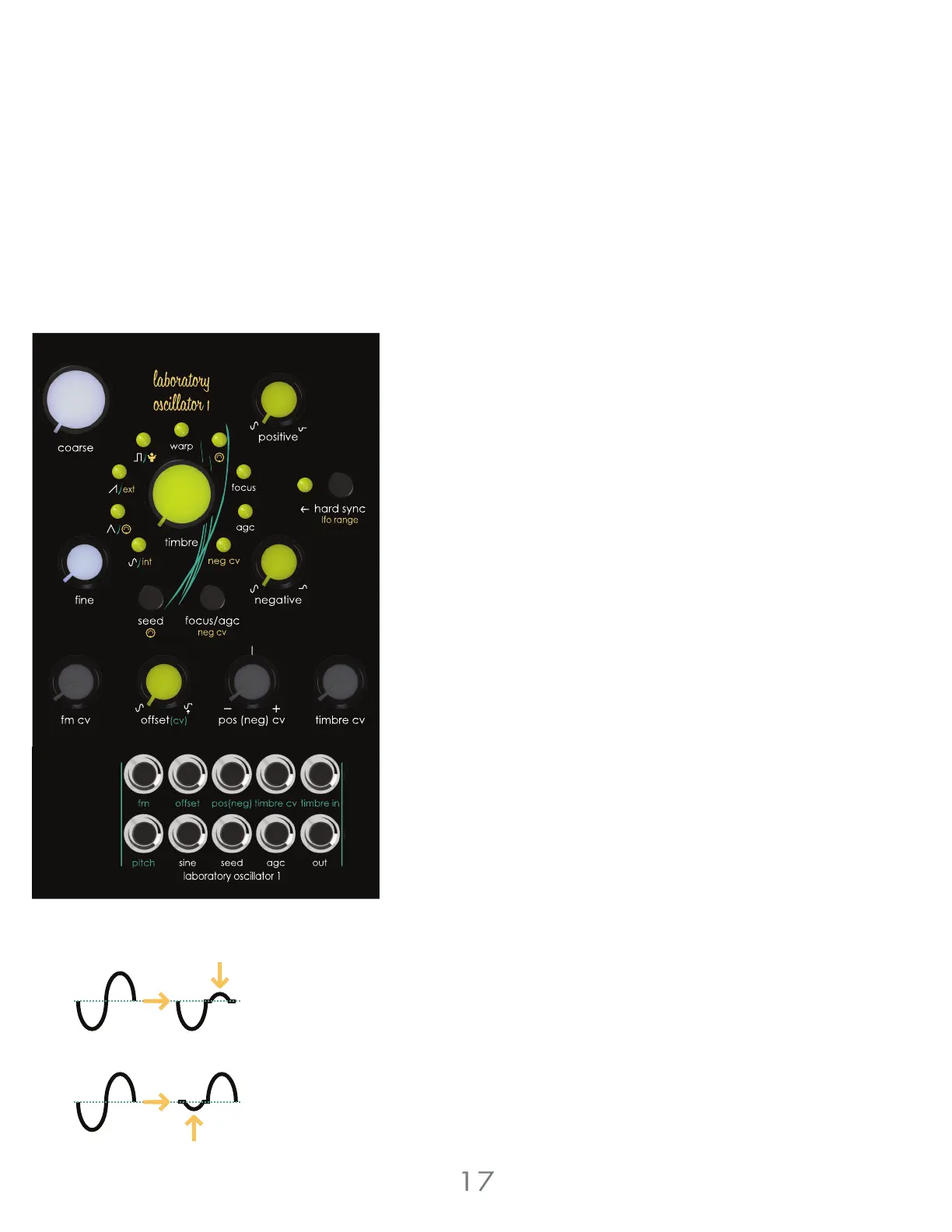
Center Clipping
Expanding on a concept mentioned but never implemented by Don
Buchla, the Voltage Lab 2 introduces Center Clipping and Automatic
Gain Control to analog synthesis.
Center Clipping is a method of shaping a waveform from the inside out.
Independently pulling the top half or bottom half of a waveform toward
the middle. The process looks like the waveform is sinking into the center
of the wave, while the rest of the wave remains unchanged finally
resulting in a half wave rectified or dual half wave rectified waveform.
This process allows independent control over even and odd harmonics.
The complex wave shaping capabilities of Center Clipping come at a
cost. Center Clipping is a destructive process that can dramatically
reduce the amplitude of waveforms. Automatic Gain Control (AGC) is
the process of attempting to restore the center clipped waveform by
allowing the analog circuitry to guess what the waveform should look
like. Results will vary.
Center Clipping and AGC output a complex set of voltage controllable
waveforms perfect for further processing with a wave folder and/or filter.
3 Voltage Lab 2 Voice Modules
Negative
Clipping
Positive
Clipping


 To Next Page