5
Voltage Lab 2 Overview:
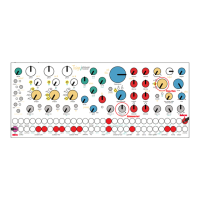
The Pittsburgh Modular Voltage Lab 2 is a cutting edge synthesis laboratory that offers a new palette of analog textures and
waveforms to sonic researchers. Newly developed wave shaping capabilities paired with powerful synthesis tools, and a
deep, performance oriented controller join together to create a complete sound design laboratory. This instrument has a
very physical sound. The tones it creates feel natural and alive, with traditional waveforms becoming the seeds of unique
new shapes and sounds that shift between analog physical modeling and more unfamiliar, abstract timbres.
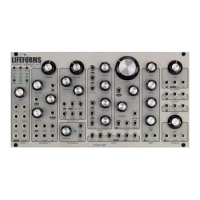
The Voltage Lab 2 contains two independent 90hp sections: the Voltage Lab 2 Voice, and the Touch Controller 2. While they
are designed to work together, with functions and I/O that complement each other, there are no pre-patched connections
between the two sections. Certain button and jack labels are present in both sections, and it’s important to remember they
are totally separate. Each section has its own edit button, its own clock settings, and its own MIDI. No signals will be sent
between the two sections unless you patch those connections in.
The Voltage Lab 2 signal path is divided into two types of signals: audio signals and control voltages. The audio signal is the
sound that is produced. The audio signal path starts at an oscillator or other sound source. The audio signal is then patched
through other functions used to shape the sound such as a wave folder or dynamics module.
Control voltages (CV) manipulate the audio signal in several different ways. Gates are represented by a high (5 volts) or low
(<= 0 volts) control voltage. A gate can be generated using a pulse or square wave from an oscillator or modulation source,
or by using the MIDI gate or clock output. A gate can be shaped using an Function Generator to control the attack, sustain,
and release of the gate. The modified gate signal can then be sent to any CV input on Voltage Lab 2.
A second use for control voltages is as a modulation source. For example, a control voltage from the [MIDI Pitch Output]
jack patched into the [Timbre CV Input] jack on the Laboratory Oscillator 1 module controls the depth of the wavefolder
based on the midi note received. The LFO provides a separate low frequency oscillator that makes a perfect control
voltage modulation source. Audio rate modulation signals also make a great CV source for oscillator FM (frequency
modulation).
Voltage Lab 2 uses Eurorack standard 3.5mm TS mono jacks for all the patch points except for the midi jacks use a male
3.5mm TRS stereo MIDI Type A cable.
The Voltage Lab 2 interface does not distinguish between audio and control voltage signals. In theory, any output can be
patched into any input. In practice, inputs respond best when patched to the expected signal type. However,
experimentation can yield surprising results. The type of signal input and output of each jack is covered in the corresponding
section.
2 Voltage Lab 2 Overview


 To Next Page