7
Control
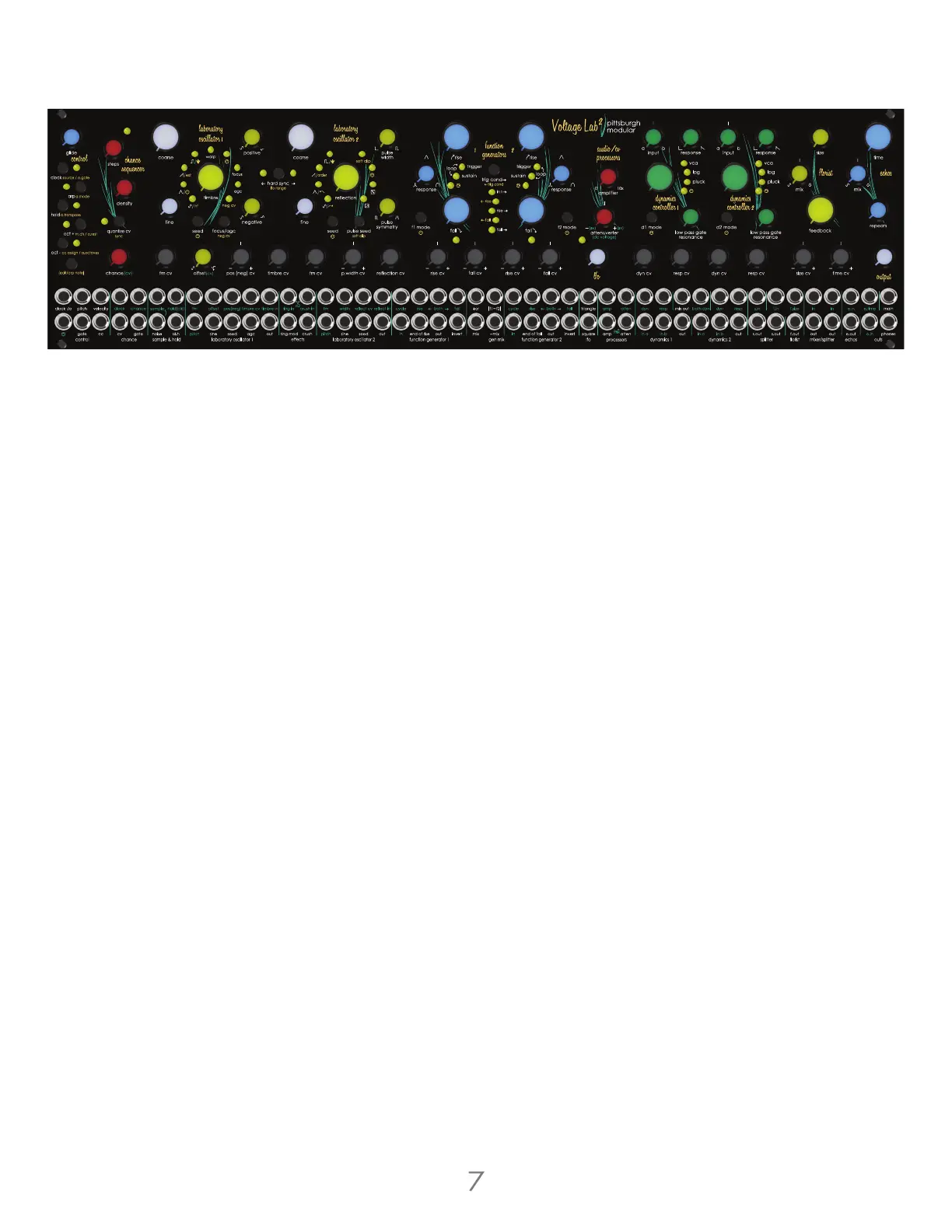
The digital control module includes a MIDI to CV converter, tap tempo clock source, octave shifting, and a 32 step
arpeggiator / sequencer.
Chance Sequencer
A digitally controlled random source generating evolving CV and gate signals.
Noise and Sample & Hold
Analog noise and fully patchable sample and hold section.
Laboratory Oscillator 1
Laboratory Oscillator 1 introduces Center Clipping to synthesis. Center Clipping unlocks independent control over the top
and bottom of the waveform, allowing for detailed manipulation of harmonics and timbre without affecting pitch.
Laboratory Oscillator Interplay
The interplay between the two laboratory oscillators can be harnessed in several ways. Ring modulation, bit crushing,
frequency modulation, and bi-directional hard sync are all available to create the widest possible range of sounds.
Laboratory Oscillator 2
Laboratory Oscillator 2 introduces Pulse Symmetry to synthesis. Pulse Symmetry creates a new type of pulse wave with the
addition of a variable height step.
Function Generators
Multi-purpose modulation tools.
Audio / CV Processors and LFO
Two independent processors that can be summed together along with a simple dual range low frequency oscillator.
Dynamics Controllers
A modern interpretation of Don Buchla’s famous “lopass” gate.
Signal Splitter and Signal Mixer/Splitter
Two utilities used to split and or mix audio and CV signals.
Audio Effects
The Florist is a flanger, chorus, springy-feedback, reverb-y, vibrato, robot sound generator with highly controlled feedback.
Echos is a moody BBD delay that secretly moonlights as a low-fi vibe machine.
3 Voltage Lab 2 Voice Modules


 To Next Page