The RAID 0 array does not backup data, so it is not regarded as a real RAID application. If one of the
hard disks is damaged, the entire array will fail, and all data in the array will be lost. Therefore, the fault
tolerance of RAID 0 is lower than that of any hard disk in the array. However, RAID 0 is still the term
widely used to describe these arrays. It is because that its basic idea is similar to real RAID application.
Notice : 1. We strongly suggest you to use two hard drives with the same brand name and capacity to get the
best compatibility.
2. If you use two hard drives with different capacity to build RAID 0, the storage space added to the array
by each disk is limited to the size of the smallest disk.
Ex: 1×320GB HDD + 1×500GB HDD Total Capacity=320GB×2=640GB
However, there is an exception under Linux O.S. The space added to the array by each disk will be the
sum of two hard drives.
Ex: 1×320GB HDD + 1×250GB HDD Total Capacity=820GB
RAID 1: Mirroring (High security; at least 2 hard disks required)
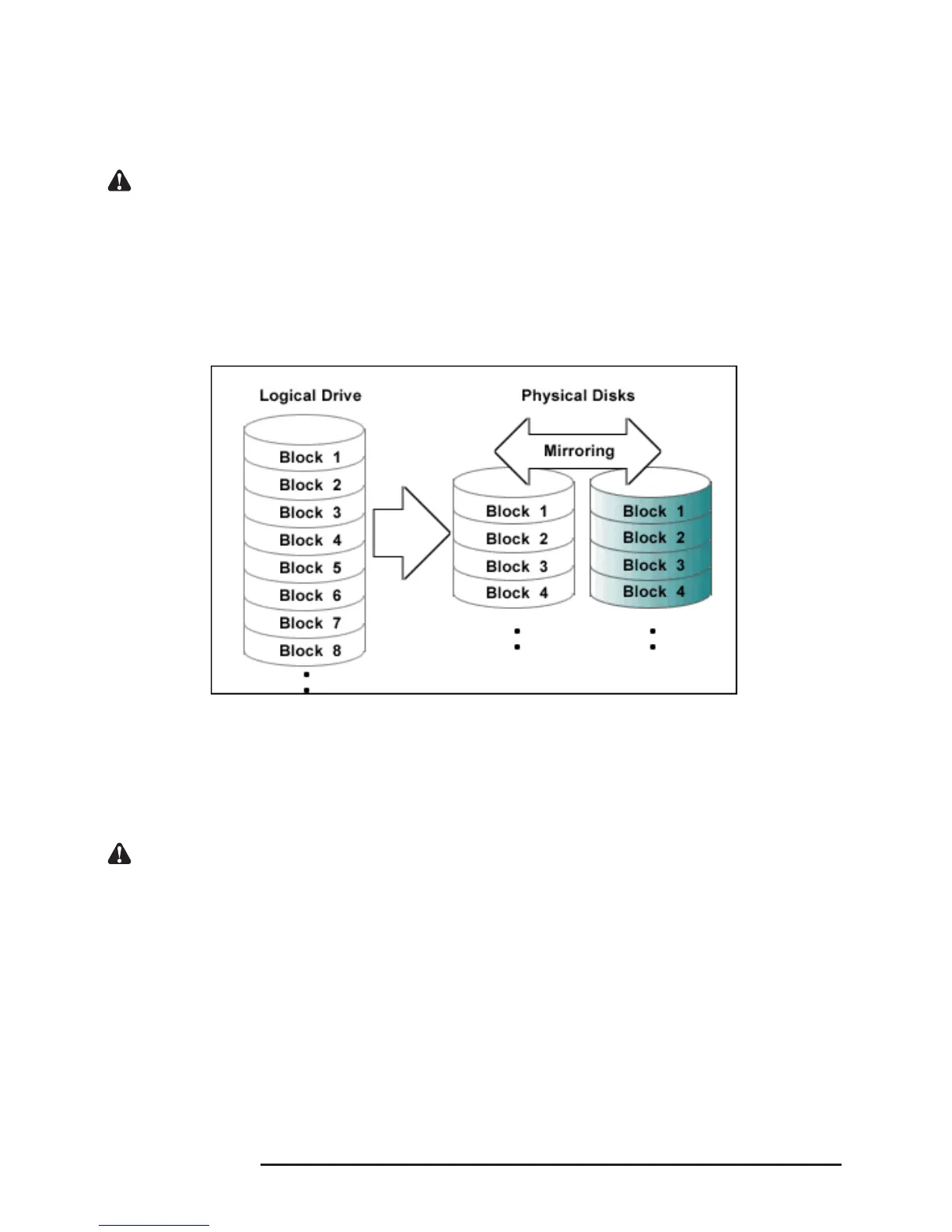
In the RAID 1 array (commonly referred to as mirroring array), hard disks are paired up; each of the
two disks contains identical data. As data is written into the mirroring array, it will be written at once and
read simultaneously. Mirroring array is highly reliable. Because it will not fail until the paired hard disks
fail at the same time. For instance, in a mirroring array of ve-pair hard disks, even as many as ve
hard disks fail, the array still can maintain the data integrity --as long as each pair has one good hard
disk left.
Notice : We strongly suggest you to use two hard drives with the same brand name and capacity to get the best
compatibility. If the capacity of two hard drives is different, the total capacity will be counted with the small
capacity. For example: 1×320GB HDD + 1×500GB Total Capacity=320GB


 To Next Page