7.8 Continuous control
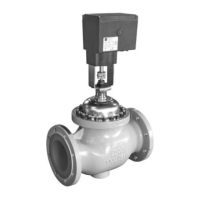
The flow temperature can be controlled using a PID algorithm. The valve receives an analog
0 to 10 V signal. When a system deviation occurs, the proportional component immediately
causes the 0 to 10 V signal to change (the greater
K
P
, the greater the change). The integral
components becomes effective with time:
T
N
represents the time which elapses until the inte-
gral component has changed the output signal to the same extent as the immediate change
performed by the proportional component (the greater
T
N
, the slower the rate of change).
Due to the derivative component, any change of the system deviation is incorporated into the
output signal with a certain gain (the greater
T
V
, the stronger the change).
Functions
WE Configuration
Control mode
three-step/0 to 10 V
1
2.0
120 sec
0 sec
45 sec
CO1, 2, 3, 4 -> F12 - 1, Y_
K
P
(proportional gain) / 0.1 to 50.0
T
N
(reset time) / 1 to 999 sec
T
V
(derivative-action time) / 0 to 999 sec
T
Y
(valve transit time) / 5, 10, 15, ..., 240 sec
7.9 Releasing a control circuit/controller over the binary input
The release of an individual control circuit or the controller using the binary input only be-
comes effective when the respective control circuit is in automatic mode (icon ). The re-
leased control circuit always works in automatic mode; the deactivated control circuit be-
haves as if it were transferred to stand-by mode. It remains active, however, in any case for
processing of external demand. The control circuit can be released using the binary input
when the binary input is either open (bE = 0) or closed (bE = 1).
Note: In systems with supplementary heating circuit without a valve (Anl 2.x, 4.x), BE15 only
influences the operation of this heating circuit when the release Rk1 function is configured,
while the operation of the entire controller (except for processing of an external demand) is
affected when the release controller function is configured. In systems which only have sup-
plementary heating circuits with or without DHW heating (Anl 3.x, 5.x), BE15 influences the
operation of the entire controller (except for processing of an external demand).
Functions
WE Configuration
Release Rk1 at BE15 0 CO1 -> F14 - 1*
Release Rk2 at BE16 0 CO2 -> F14 - 1*
Release Rk3 at BE17 0 CO3 -> F14 - 1*
EB 5579 EN 99
System-wide functions


 To Next Page