Date Code 20000421 Applications 5-1
SEL-251, -2, -3 Instruction Manual
SECTION 5: APPLICATIONS
This section is included as a tool for applying the SEL-251 Relay. The information does not
represent suggested settings or standards. Please refer to Section 2: Specifications and
Section 3: Communications and be sure the settings you choose result in relay performance
appropriate to your application.
FUSE-SAVING SCHEMES
In a fuse-saving scheme, the SEL-251 Relay should trip instantaneously for faults on the load
side of tap fuses near the substation, attempting to save the fuse if the fault is transient. If the
fault is permanent, the fuse will eventually operate on a subsequent shot where relay tripping is
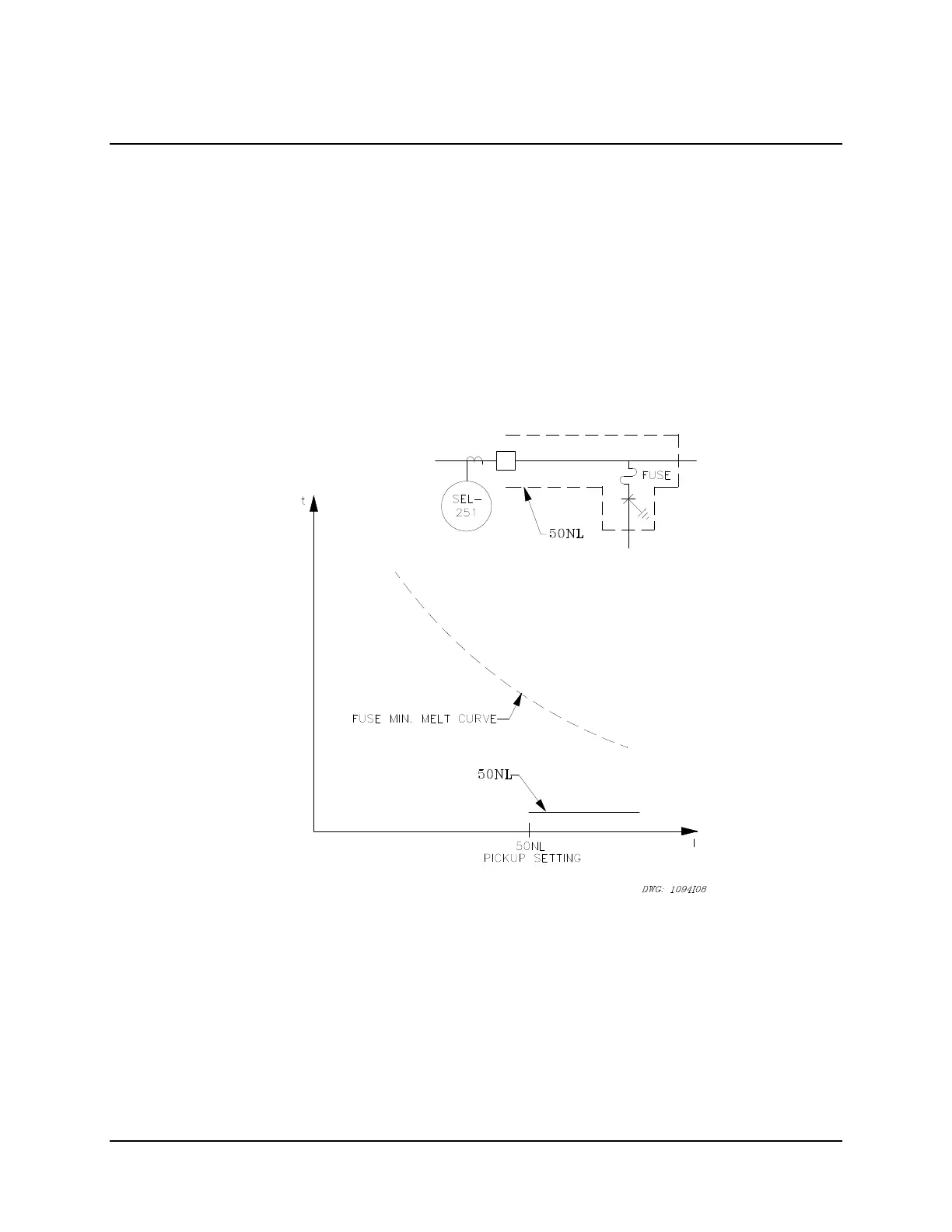
delayed. The 50NL ground/residual instantaneous overcurrent element in Figure 5.1 is incor-
porated in fuse-saving schemes in the following examples.
Figure 5.1: Fuse Saving Using Ground/Residual Elements
At least two fuse-saving scheme implementations are possible. One scheme uses the 79SH Relay
Word bit while the other scheme uses the 52AT Relay Word bit. In the following examples, the
goal is to enable element 50NL for the first one or two shots and disable it for the remaining
shots. With 50NL disabled, the tap fuses operate if the fault is permanent. More information
about these two schemes appears below.


 To Next Page