Date Code 20000421 Installation 6-1
SEL-251, -2, -3 Instruction Manual
SECTION 6: INSTALLATION
INSTALLATION: CONVENTIONAL TERMINAL BLOCK MODEL
Mounting
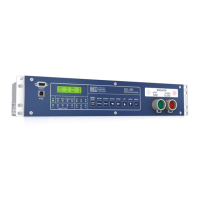
The relay is designed for mounting by its front vertical flanges in a 19" vertical relay rack. It
may also be mounted semi-flush in a switchboard panel. Use four #10 screws for mounting.
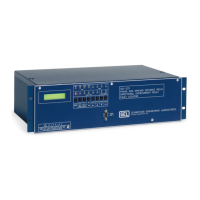
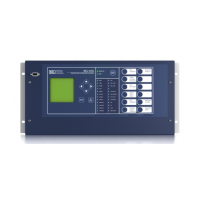
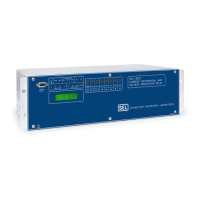
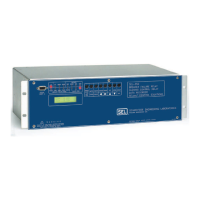
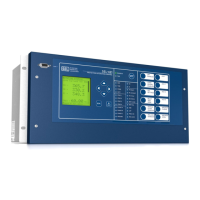
This section includes front and rear panel drawings.
Frame Ground Connection
Terminal 46 on the rear panel must be connected to frame ground for safety and performance.
These terminals connect directly to the chassis ground of the instrument.
Power Connections
Terminals 44 and 45 on the rear panel must be connected to a source of control voltage. Control
power passes through these terminals to the fuse(s) and a toggle switch, if installed. The power
continues through a surge filter and connects to the switching power supply. The control power
circuitry is isolated from the frame ground.
Secondary Circuits
The relay presents a very low burden to the secondary potential and current circuits. It requires
three currents from the power system current transformer secondaries.
The four-wire wye potential from potential transformer secondaries is optional. It is used for
fault locating, voltage and MW/MVAR metering, and undervoltage torque control.
Control Circuits
The control inputs are dry. For example, to assert the IN5 input, you must apply control voltage
to the IN5 input terminals. Each input is individually isolated, and a terminal pair is brought out
for each input. There are no internal connections between control inputs.
Control outputs are dry relay contacts rated for tripping duty. A metal-oxide varistor protects
each contact.
Communications Circuits
Connections to the two EIA-232 serial communications ports are made via the two 9-pin
connectors labeled Port 1 and Port 2R on the rear panel and Port 2F on the front panel. Pins 5
and 9 connect directly to frame (chassis) ground. See Table 3.1 for pin assignment.
Warning: Do not rely upon pins 5 and 9 for safety grounding, since their current-carrying
capacity is less than control-power short circuit current and protection levels.


 To Next Page