Date Code 20000421 Applications 5-3
SEL-251, -2, -3 Instruction Manual
i.e., 50NL is enabled for tripping for shot = 0 and shot = 1 only. If the reclosing relay is reset
(shot = 0) and a permanent ground fault occurs beyond the tap fuse in Figure 5.1 (ground fault
3I
0
current > 50NL), the 50NL element trips the feeder circuit breaker twice. Thus, the tap fuse
is "saved" during initial trip (shot = 0) and the subsequent trip after the first reclosure (shot = 1).
For the second reclosure (shot = 2), 50NL is not enabled for tripping (shot = 2) and the tap fuse
clears the permanent fault. Figure 5.2 details this reclosing cycle.
If the ground fault was transient, the 50NL element would have tripped the circuit breaker the
first time (shot = 0), extinguishing the fault, and the tap fuse would have been saved.
Fuse-Saving Scheme Using the 52AT Bit
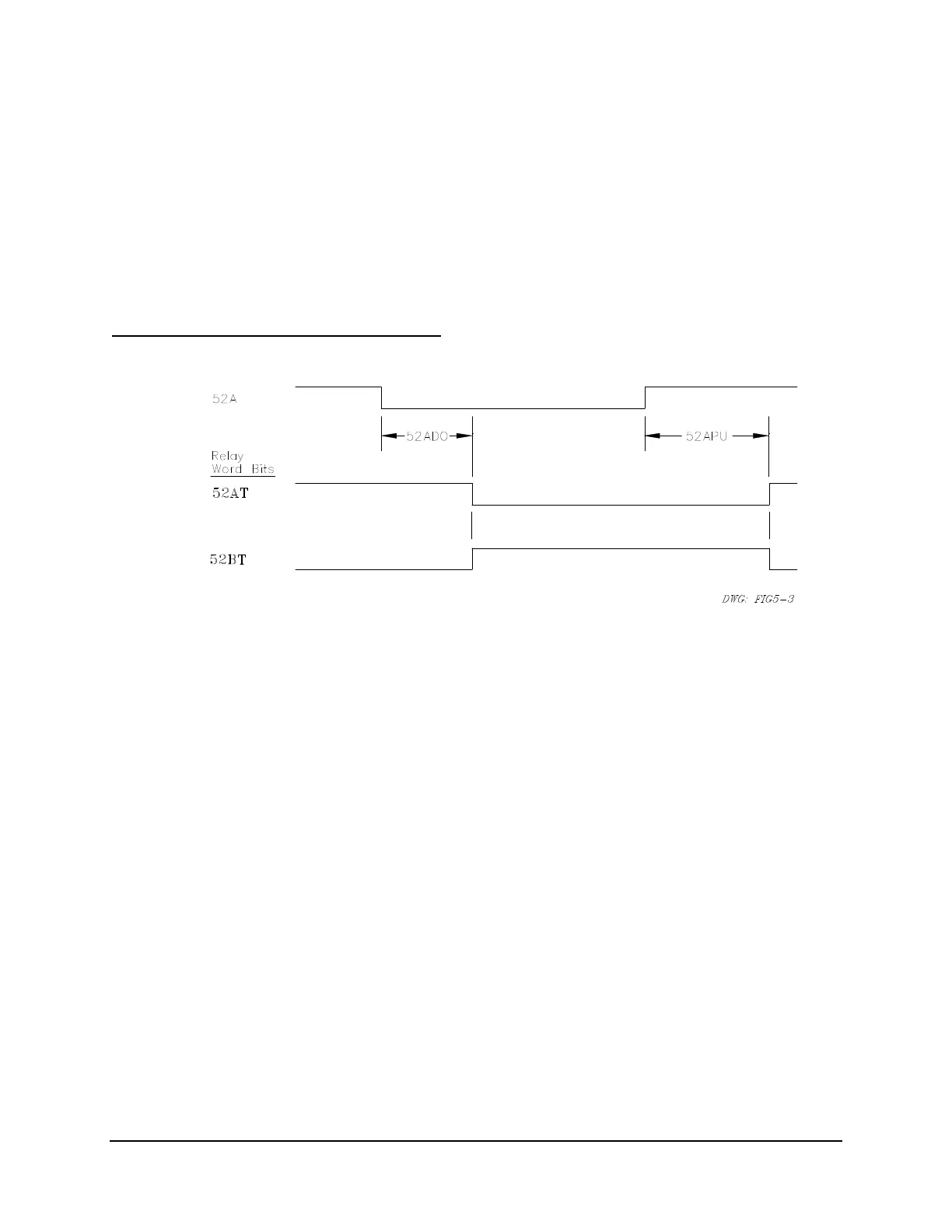
The 52APU and 52ADO settings affect Relay Word bits 52AT and 52BT as follows:
Figure 5.3: Effect of 52APU and 52ADO Settings on Relay Word Bits 52AT and 52BT
Note that the 52BT bit is the inverse of the 52AT bit. The discussion involves only the 52AT
bit.
If 50NL is supervised by 52AT, 50NL continues to be disabled for 52APU time after circuit
breaker closure. 52A asserts when the circuit breaker closes.
Using SELOGIC Control Equations:
B(12) = 50NL
E(34) = 52AT
V(56) = B*E
TR(1246) = V+... (TR is the programmable trip condition)
effectively, TR(1246) = 50NL*52AT+...
close TRIP output contacts = TR + ...
If the circuit breaker has been closed longer than 52APU time before a fault occurs, 52AT = 1
and 50NL is enabled for tripping. If a permanent ground fault occurs beyond the tap fuse in
Figure 5.1 (ground fault 3I
0
current > 50NL), the 50NL element trips the feeder circuit breaker.
The circuit breaker opens. The reclosing relay closes the circuit breaker after the first open
interval time expires.


 To Next Page