5-22 Applications Date Code 20000421
SEL-251, -2, -3 Instruction Manual
FEEDER RELAY SETTING CHANGES
When a faulted feeder section is isolated and customers beyond the fault are backfed, the feeder
configurations are different. One is shorter with less load, while the other is longer with more
load. Save setting groups for different feeder configurations to optimize protection.
You can parallel one feeder with another for breaker maintenance. Program setting groups for
normal or parallel operation.
BUS-TIE RELAY SETTING CHANGES
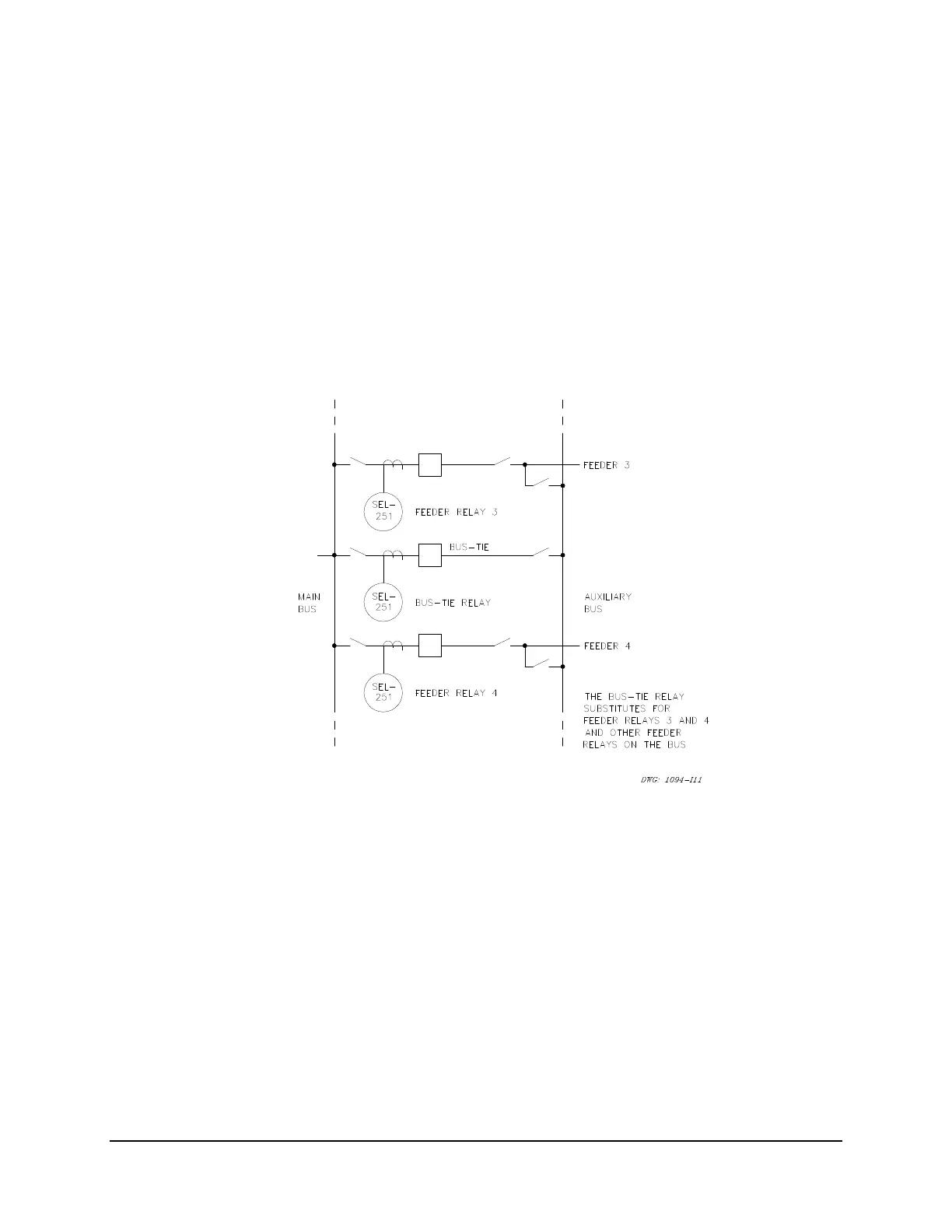
In stations where bus-tie breakers substitute for feeder breakers during maintenance, the bus-tie
breaker relay can have a setting group for each feeder it protects.
Figure 5.14: Main/Auxiliary Bus with Bus-Tie Circuit Breaker
CLOCK-DRIVEN SETTING GROUP SELECTION
Consider seasonal, weekend/weekday, and daily system changes. Develop optimum settings for
various times, and use clock contacts to select appropriate settings.
DEMAND-DRIVEN SETTING GROUP SELECTION
Trigger a change to less sensitive settings when demand (phase, negative-sequence or
ground/residual) encroaches on relay settings, thus avoiding nuisance trips. Set an alarm so
problems can be investigated.


 To Next Page