Date Code 20000421 Applications 5-7
SEL-251, -2, -3 Instruction Manual
effectively, TR(1246) = 50L*(79RS+79CY+ST)+...
close TRIP output contacts = TR + ...
79RS = 79CY = 0 when the relay is in the lockout state. 79RS + 79CY = 1 when the relay is not
in the lockout state. Thus, ST effectively supervises 50L only when the relay is in the lockout
state. TSDO can be set to any value. 50L is enabled while the reclosing relay is cycling. The
79RST setting should be greater than the TSPU setting.
If setting 50C is greater than minimum load levels, 50L is disabled from initiating tripping during
minimum load times. If a fault occurred during minimum load times, 50L would be delayed
from operating for the fault for TSPU time.
Blocking Scheme for Cold Load Inrush Using the 52AT Bit
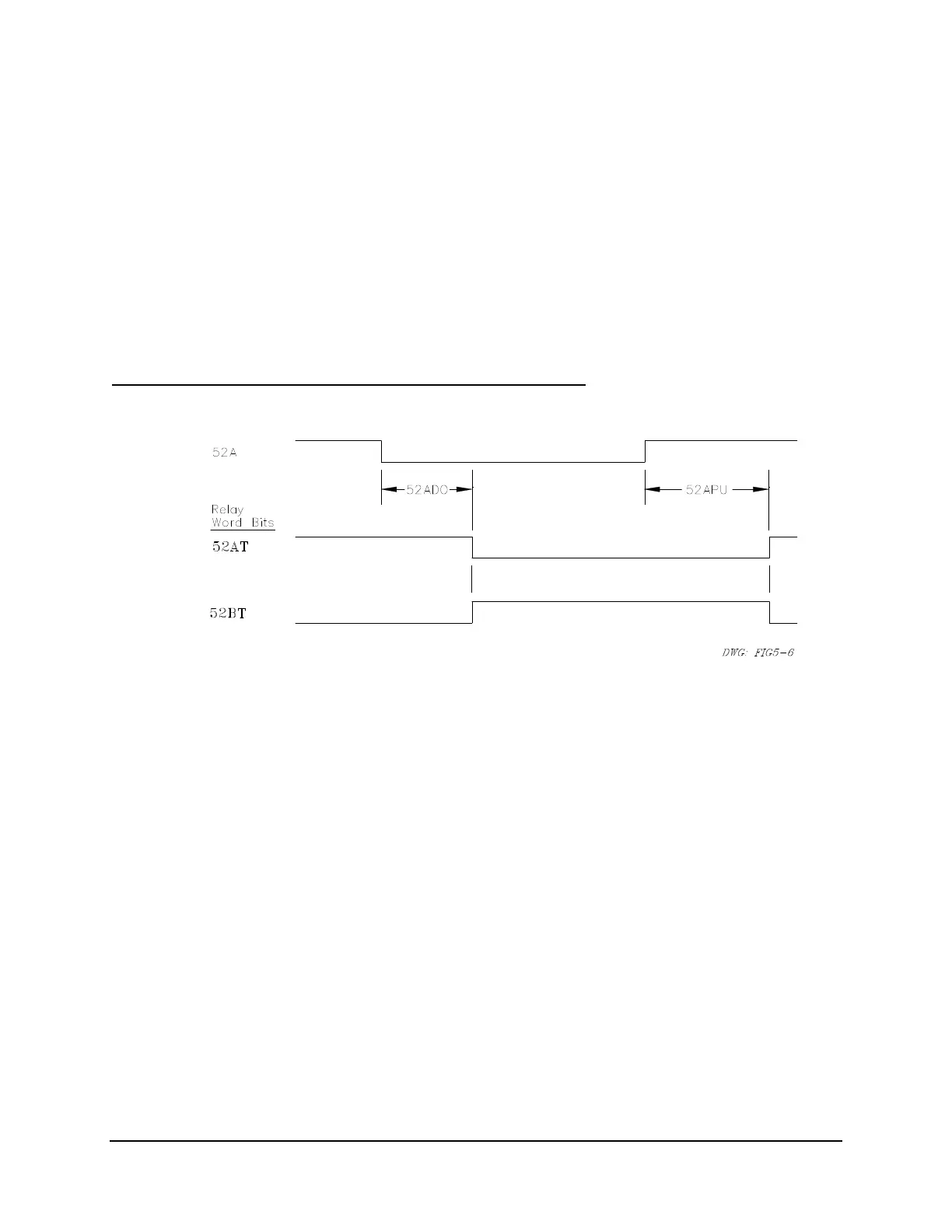
The 52APU and 52ADO settings affect Relay Word bits 52AT and 52BT as follows:
Figure 5.6: Effect of 52APU and 52ADO Settings on Relay Word Bits 52AT and 52BT
Note that 52BT is the inverse of 52AT. This discussion involves only 52AT.
If 52AT supervises 50L, 50L continues to be disabled for 52APU time after circuit breaker
closure. Set 52APU slightly greater than the potential cold load inrush time.
Using SELOGIC Control Equations:
B(12) = 50L
E(34) = 52AT
V(56) = B*E
TR(1246) = V+... (TR is the programmable trip condition)
effectively, TR(1246) = 50L*52AT+...
close TRIP output contacts = TR + ...
If setting 52ADO exceeds all reclosing relay open interval time settings (79OI1, 79OI2, etc.),
52AT will not drop out during the reclose cycle, leaving 50L enabled throughout the reclose
cycle. 52AT drops out when 52ADO time expires after the recloser goes to lockout (the circuit
breaker is open and 52A = 0). This may be desirable since open interval times are not long


 To Next Page