Rev 37 Operator’s Manual OM-610-1002-1
page 34 SECTION 5 OPERATION PDS-2010
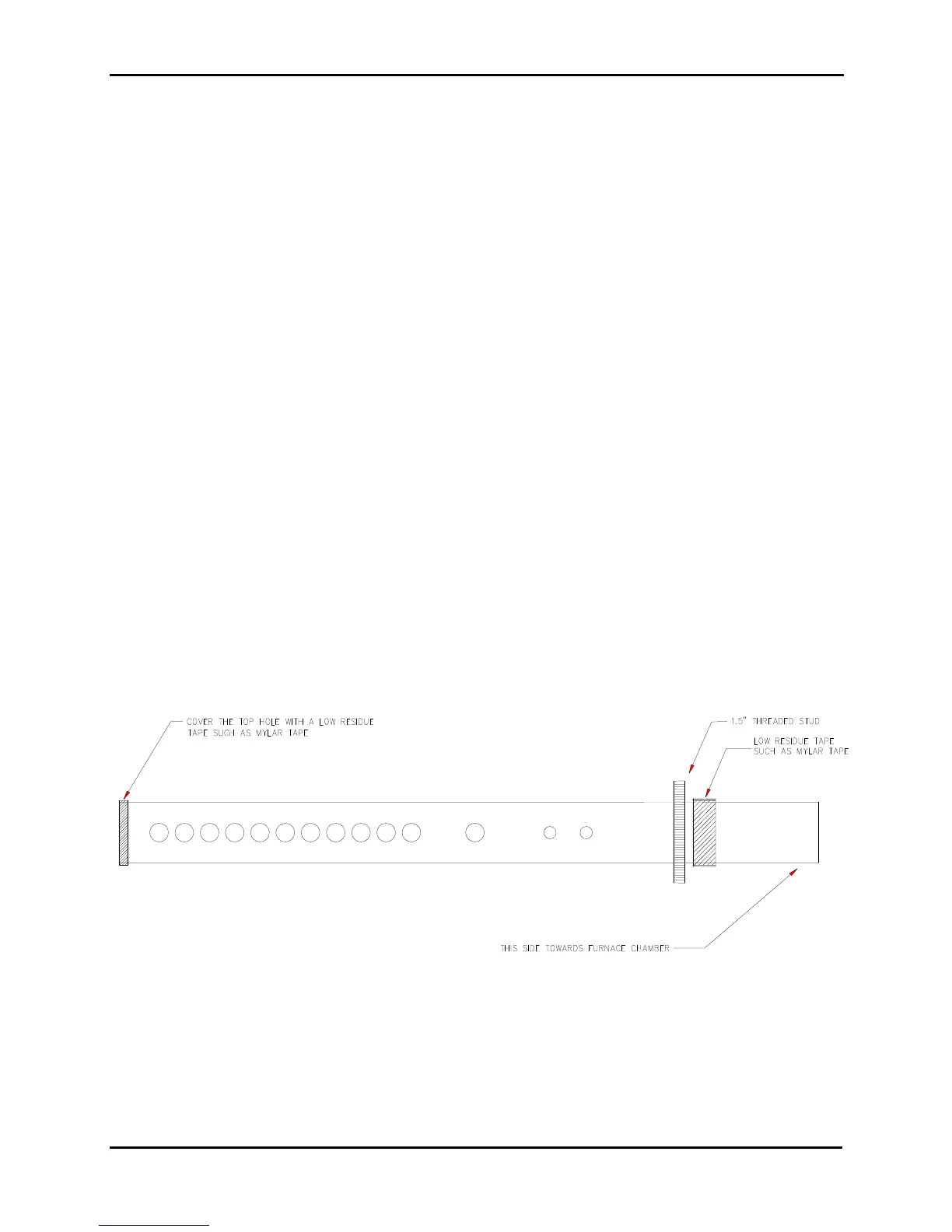
Figure 8: Baffle Installation
When a large amount of substrate is to be coated, use care to position the substrate to minimize the shadowing
effect that individual parts may have on one another. Also, maintain a minimum spacing requirement of 1/2"
between parts in dense loads.
Rotation of the fixture helps distribution, and rotation is standard for the 2010. Using rotation helps distribute
any non uniformity of the coating over the entire fixture; however, it will not typically help distribution
variances from the top to bottom of the chamber.
5.14.5 Pump Down Time
The time necessary to pump the Deposition Chamber to a low enough pressure to initiate deposition will vary
greatly depending on the amount of substrate and the outgassing associated with the substrate. The pump
down time can vary from less than 15 minutes to 4 hours or more.
5.14.6 Vacuum System Leaks
Small leaks in the vacuum system will increase the pump down time and lower the overall efficiency of the
2010. Relatively large leaks can affect the quality of the Parylene coating.
5.14.7 Baffle
The chamber inlet baffle is extremely important for the even distribution of monomer gas in the deposition
chamber. A warped, damaged, poorly installed, or heavily coated baffle can cause coating thickness variations
and distribution anomalies within the chamber. Use a standard taping scheme in order to provide a consistent,
repeatable method of installing the baffle.
To install a flute baffle, insert a 1.5” long threaded stud (PP-578-1002-0) in the first hole as shown in the
figure below. Use a low residue tape (e.g., Mylar or glass cloth tape) around the area just below the stud
in order to increase the thickness so that the baffle will fit in the furnace chamber. When installing the
baffle in the chamber, make sure that the holes face towards the chamber wall.
5.15 ADHESION PROMOTION (WET PROMOTION)
Silane A-174 is available for adhesion promotion if improved Parylene adhesion is desired. Two types of
AP are possible: 1)Wet Promotion, which is a treatment process that is performed on the product before it
is loaded in the coating machine, and 2)In-Chamber Promotion, which is an option offered on some of the


 To Next Page