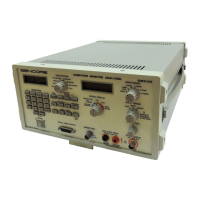
SP395 SoundPro Audio Integrator Form7492 Operation Manual
2
SP295 generator or an external sound pickup such as a handclap. Valuable in setting time
delays from speaker to listening positions and analyzing sound decay for reflections or
decay time.
• Reverb Decay Time (RT60): Measures and computes reverb decay time or the time it
takes the sound in a room to decrease 60 dB. The measurement computes wideband RT60
(20Hz-20 kHz) or the RT60 of any octave band.
• Multi-Band Decay: Measures, computes and displays the reverb decay time RT60 for
seven audio octave bands simultaneously to identify differences in room sound absorption
characteristics in each band.
• Time Delay Analysis: Times a swept audio generator (20-20,000Hz) and tracking audio
1/12 octave band level meter, with a variable filter Q of 6 to 150, graphing the detected
level. Measurement eliminates room reverberations or echoes for accurate frequency
response testing of speakers or microphones.
• Speech Intelligibility: Measures speech intelligibility using the most popular industry
standards including ALCONS, RaSTI and STI-PA. A CD with the proper test signal for
these tests is provided.
• Noise Curve: Measures noise in a room and characterizes it to a numeric value taking into
account how the human ear hears. Performs standard NC or NCB (balanced noise curves),
RC (Room Criteria), and PNC (preferred noise curve) ANSI tests.
• Transmission Loss: Measures sound transmission loss through a partition. Computes
STC, RW and OITC standard transmission loss measurements by comparing 1/3 octave
RTAs from the source and received sound.
• Audio Stethoscope: Combines the microphone input and sensitive audio preamplifier with
the audio monitoring headphones to form an audio stethoscope. Weighted filters and
octave or 1/3 octave band filters may be selected.
• Level/Freq. Meter: Measures two channel left and right audio input levels from -120 dBu
to +40 dBu and sine wave frequency from 10 Hz to 32 kHz. Measures dBu, dBV, Vave,
Vrms, Vp-p and dBr.
• Signal Generator: Generates audio test signals including sine wave to 22 kHz, square
wave, pink noise and white noise with variable output level. Also outputs octave or 1/3
octave band limited pink noise.
• Amplitude Sweep: Plots the frequency response of audio equipment by sweeping the
generator through its frequency range and graphing the amplitude input level of each 1/12
octave.
• Distortion Meter THD: Measures THD+N (Total Harmonic Distortion plus Noise) of an
incoming signal by comparing the level of the incoming signal with the level of harmonics
and noise.
• Distortion Meter IMD: Measures IMD (Inter-modulation Distortion) of an incoming
signal by outputting a multi-frequency output test tone and measuring the distortion
components. Performs SMPTE IMD and DIN IMD tests.
• Phase Meter: Measures the phase difference between left and right input sine waves of the
same frequency.
• Crosstalk Meter: Measures the amount of dB isolation between the left and right input
audio sources or the signal bleeding from one channel into the other.
• Speaker Polarity: Determines the polarity of the speakers to determine proper wiring.
• Speaker Distortion: Tests speaker distortion, using the THD+N test function, to identify
speaker defects or performance problems.
• Impedance Meter: Measures the impedance of an audio device or component such as a
speaker. The frequency of the test is variable. Also indicates watts or amplification
required at a particular voltage.


 To Next Page