10.3.2 CiA 406 device profile
A device profile describes a certain “class” of devices such as drives, sensors, regu‐
lators, etc. based on the corresponding parameters. The CiA 406 device profile imple‐
mented in the device represents an encoder profile. The device profile is divided into
different classes. The device supports the “Absolute linear encoder Class 2” device
profile (device type = 0196h, encoder type = 0008h) according to CiA 406 version 3.2
(absolute linear encoder).
10.3.3 Object directory
The complete range of functions of a CANopen device is organized with the associ‐
ated parameters (objects) in table form. Within this object directory, each object is
addressed via an index.
The object directory is divided into three different parts:
•
Communication segment
•
Manufacturer-specific segment
•
Device-specific segment
10.3.4 EDS file
The functionality of a CANopen device is described in the “electronic data sheet” (EDS).
Manufacturers, supported baud rates and all objects from the object directory, for
example, are listed there.
You can download the EDS file from the product page.
The call is made via the SICK Product ID: pid.sick.com/{P/N}/{S/N}
{P/N} corresponds to the part number of the product, see type label.
{S/N} corresponds to the serial number of the product, see type label (if indicated).
10.3.5 Telegram structure:
CANopen is based on the data link layer of CAN. There are a total of four different
telegram types: Data telegram, remote telegram, error telegram and overload telegram.
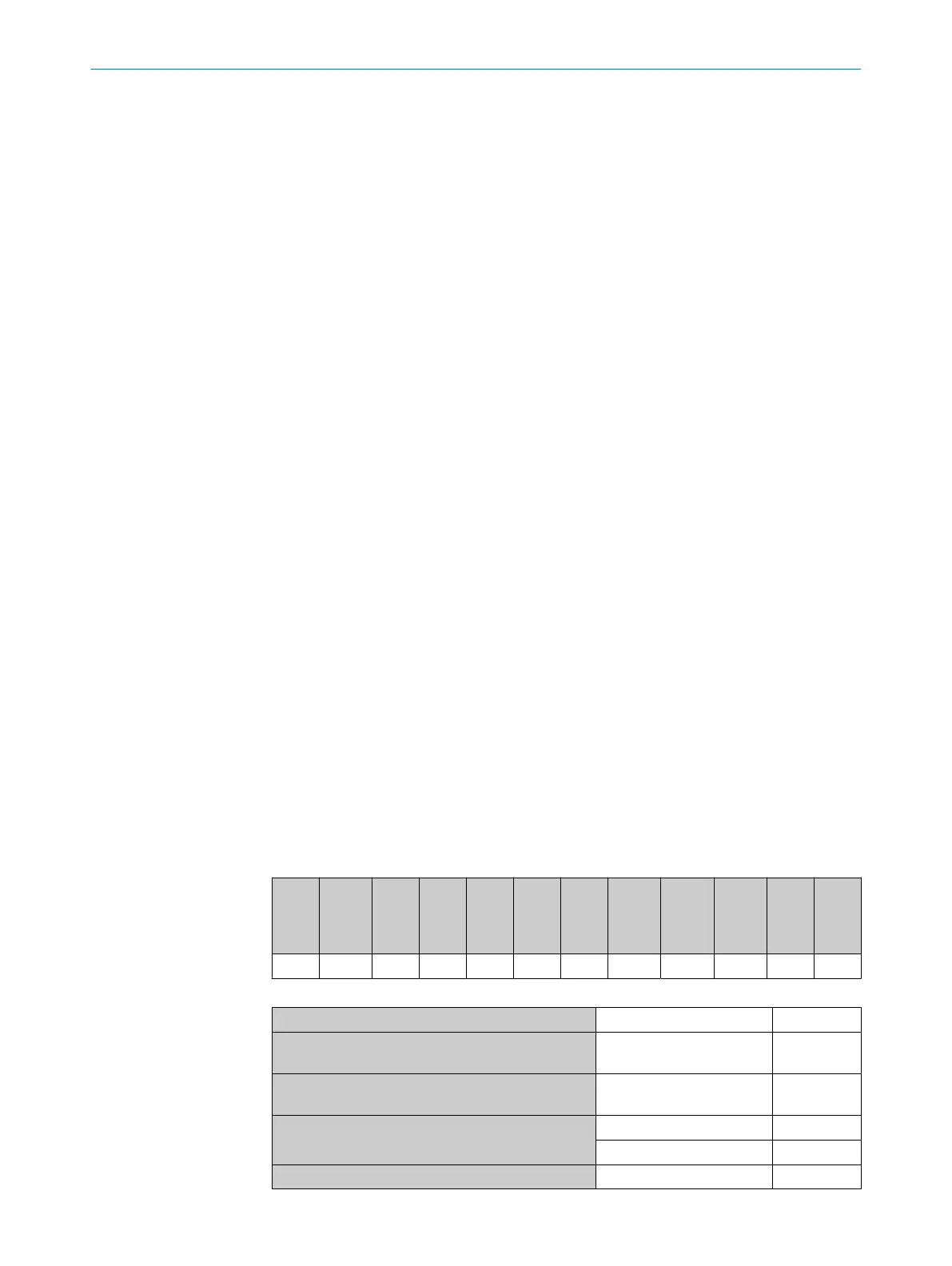
The classic CAN protocol supports two CAN data frame formats. They differ essentially
only in the length of the CAN identifier (11bits or 29bits). The device supports only the
11-bit standard format described in the following table on the basis of a data telegram.
For the user only the identifier, the data length and the user data are relevant. All other
data is processed automatically by the system.
Table 27: Telegram structure:
SOF Identi‐
fier
(CAN
ID)
RTR r1 r0 DLC Data
field
CRC
Seq.
CRC
Del.
ACK
Slot
ACK
Del.
EOF
1 11 1 1 1 4 0-64 15 1 1 1 7
Table 28: Telegram structure:
Start of Frame SOF 1
Identifier: CAN-ID (identification and priority of
data, see "Structure of 11-bit CAN ID", page 56)
Identifier (CAN ID) 11
RTR: Remote Transmission Request (differentia‐
tion between data and remote telegram)
RTR 1
r1, r0: reserved r1 1
r0 1
DLC: Data Length Code DLC 4
CANOPEN INTERFACE 10
8015418/19HA/2022-12-15 | SICK O P E R A T I N G I N S T R U C T I O N S | DL100 Pro CANopen
55
Subject to change without notice







 To Next Page