OPERATING INSTRUCTIONS | LFP INOX 8019921/15H0 / 2019-09-30| SICK AG
Irrtümer und Änderungen vorbehalten
13
3PRODUCT DESCRIPTION
3.3 Product features and functions
3.3.1 Principle of operation
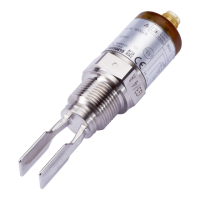
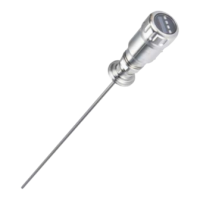
The LFP uses TDR (Time Domain Reectometry) technology.
This is a process to determine transit times of electromagnetic waves. A low-energy,
electromagnetic pulse is generated in the sensor’s electronics, coupled to the mono-
probe, and conducted along this probe.
If this pulse strikes the surface of the liquid to be measured, a portion of the pulse
is reected there and is conducted back up along the probe path to the electronics,
which then calculate the level based on the time dierence between the sent and the
received pulse.
The sensor can output this level as a continuous measured value (analog output) and
can also derive two and/or four freely positionable switching points from it (switching
outputs).
IO-Link communication is also available for the switching output (Q1),
see “8.1.3 IO-Link”.
3.3.2 Fields of application
The innovative TDR technology enables reliable level measurement which is largely
application-independent. The LFP is suitable for both continuous level measurement
and discontinuous level measurement in nearly all liquids.
The sensor is not aected by changes in the properties of the liquids to be measured.
Its hygienic design means the LFP Inox is suitable for universal use in all liquids in the
food industry.
The LFP can be used in metal containers or bypass systems.
The use at media temperatures of up to 150 °C and up to 180 °C with remote ampli-
er plus CIP and SIP compatibility mean the device is completely food safe. This has
been certied by an EHEDG certicate and FDA conformity. WHG certication is in
preparation.


 To Next Page