Page 77 of 128
14.6 Battery charging
14.6.1 Prior to first use
The SLE1000 should be connected to mains power for 8 hours prior to first use to
allow the batteries to charge.
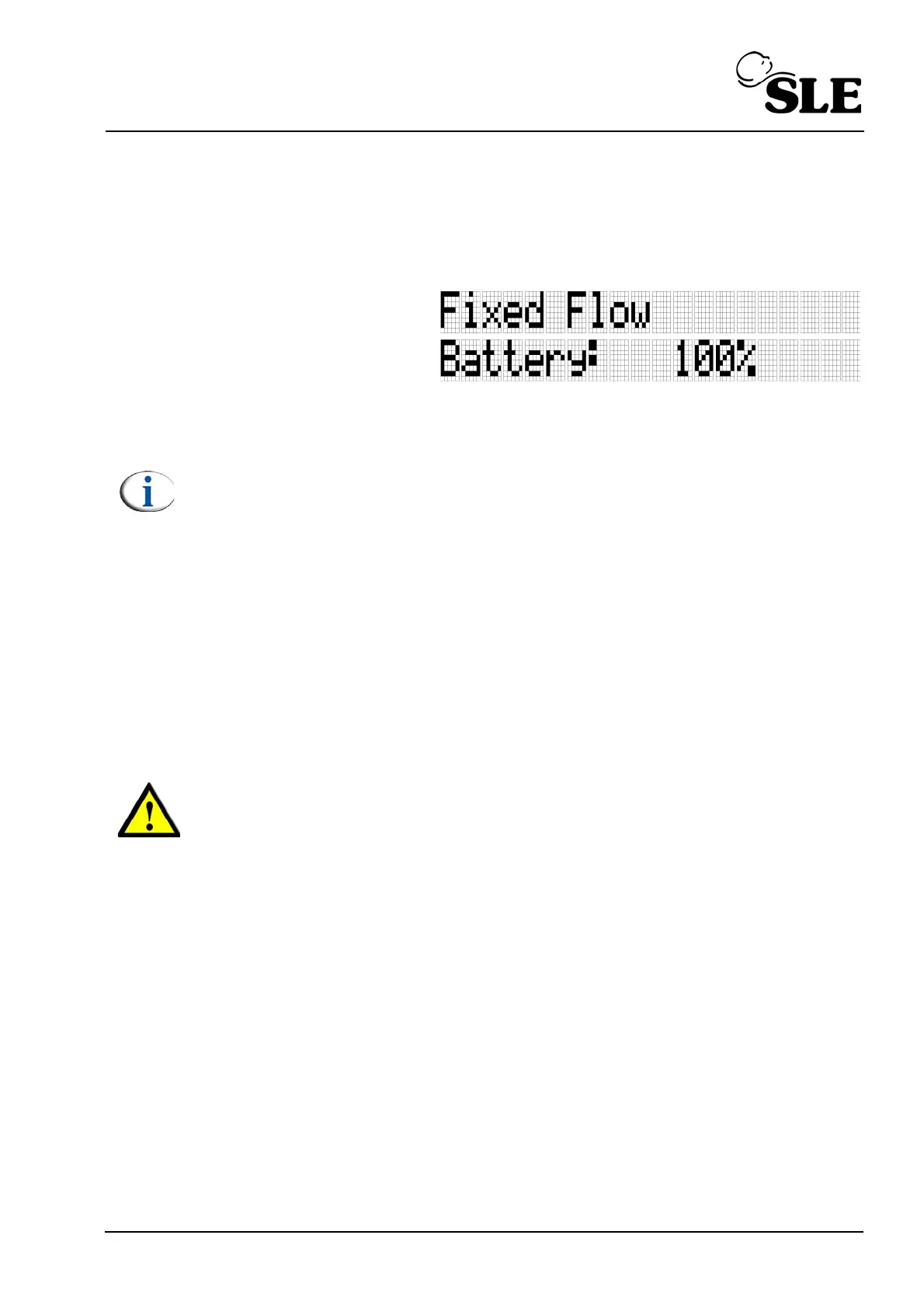
After 8 hours confirm that
the battery status indicator
reads 100%.
14.6.2 Battery charging whilst in use
The SLE1000 will charge the batteries when connected to mains.
Note: The SLE1000 does not have to be turned on for the charging to take
place.
14.7 Battery care
The SLE1000 contains 1 sealed lead acid battery that can operate the unit for
upto 4 hours in the event of a mains power fail situation. The 4 hour period stated
is for a battery that is new or for a battery that has not been allowed to remain in a
deep discharged state.
If the SLE1000 has been used on battery power and has been allowed to fully
discharge the battery, the battery can be described as being in a deep discharged
state. If the unit is stored or placed out of service without recharging the batteries,
the deep discharged state will reduce the battery life.
Warning: For a battery that has been allowed to remain in a deep
discharged state, the damage is irreversible. On re-charging a damaged
battery the service life will be curtailed.
14.8 Using the SLE1000 on battery power.
The SLE1000 is not designed to be started and used on battery power only, as it
is a mains powered device with battery backup.
If attempting to start the unit purely on battery power and the battery and mains
indicator lights are flashing whilst the power on button is depressed, the unit will
not start. Reconnect mains power and leave connected to mains for a minimum of
8 hours to fully recharge the battery.
If the unit starts on battery power and after the pneumatic and oxygen calibration
test the low battery (medium priority) alarm becomes active, restore mains power
immediately as the unit has only 10 to 20 minutes operating time left. If the low
battery (high priority) alarm is triggered the unit will shut down after 1 minute.


 To Next Page