Page 88 of 128
17. Basic operation
The following chapter describes the basic operation and is not intended to be
prescriptive.
17.1 Monitoring
The recommended patient monitoring requirements are:
1. ECG/heart rate.
2. Respiration rate
3. Blood pressure (either by invasive or non invasive means).
4. Oxygen saturation.
5. Blood gas saturation by either transcutaneous carbon dioxide arterial /
capillary blood sampling.
6. Regular cranial ultrasound examinations (in the newborn).
7. Standard nursing care for Intensive Care patients.
17.2 Operation
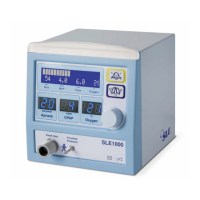
Step 1 Setup the SLE1000 as described in section 14.4 on page 73.
Step 2 Ensure that the SLE1000 has been functionally tested as described in section 15.
on page 80.
Step 3 Ensure the unit has calibrated the oxygen system.
Note: If you are using the unit with air only, the “O2 CALIB ERROR” will be
triggered. Press the alarm button twice to clear the alarm message. The unit
will display “- -”. Do not set the % O2 above 21% as this will trigger the “NO
O2 SUPPLY” alarm.
Step 4 Set the SLE1000 into the required mode.
Step 5 Prepare the patient bonnet and select the prong or mask suitable for the patient.
Step 6 Attach the generator circuit to the patient.
Step 7 Set the Apnoea alarm time.
Step 8 Adjust the % oxygen, (If the unit is connected to air only leave the setting at 21%).
Step 9 Monitor the patient condition and adjust parameters accordingly.


 To Next Page