9.3 General principles of using Ni-MH batteries
- Store the batteries (the tester) in a dry, cool and well ventilated place and protect them from direct
sunlight. The ambient temperature in the case of prolonged storage should not exceed 30C. If the
batteries are stored for a long time in a high temperature, then the occurring chemical processes may
reduce their lifetime.
- Ni-MH batteries normally withstand 500-1000 charging cycles. The batteries reach their maximum
capacity after being formatted (2-3 charge and discharge cycles). The most important factor which in-
fluences the lifetime of the battery is the depth of discharge. The deeper the discharge level of the
battery, the shorter its lifetime will be.
- The memory effect is limited in the case of Ni-MH batteries. These batteries may be charged at any
point with no serious consequences. However, it is recommended to discharge them completely eve-
ry few cycles.
- During storage of Ni-MH batteries they self-discharge at the rate of approximately 20% per month.
Keeping them at high temperatures may double the speed of this process. In order to prevent exces-
sive discharge of batteries, after which it would be necessary to format them, it is recommended to
charge the batteries from time to time (even if not in use).
- Modern fast chargers detect both too low and too high a temperature of batteries and react to the
situation adequately. Too low a temperature should prevent the start of the process of charging,
which might damage the battery irreparably. An increase of the temperature of the battery is a signal
to stop charging and is a typical phenomenon. However charging at a high ambient temperature apart
from reducing the lifetime causes an accelerated increase of the temperature of the battery, which
will be not charged to its full capacity.
- Remember that fast charging gets the batteries to be charged to approximately 80% of their capaci-
ty. Better results may be obtained if the process of charging is continued: the charger goes then to
the phase of charging with a low current and after next couple of hours the batteries are charged to
their full capacity.
- Do not charge or use batteries in extreme temperatures. Extreme temperatures reduce the lifetime
of batteries. Avoid placing devices powered from batteries in very hot environments. The nominal
working temperature must be absolutely observed.
10 Replacing fuses.
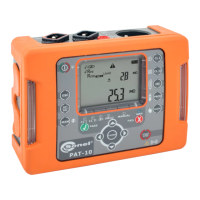
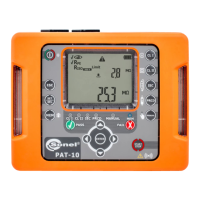
PAT-2E and PAT-10 testers are equipped with two fuses (0216016.MXP, 5x20mm 16A Littelfuse)
that are replaceable by user. When needed unscrew and remove the fuse containers on the bottom
side of the tester:


 To Next Page