Introduction
1–4 H
2
S in Natural Gas
Propulsion Laboratory (JPL) with the purpose of commercializing space proven
measurement technologies initially developed at JPL.
Typical applications include real-time measurement of moisture, carbon dioxide
and corrosives (H
2
S) in natural gas, energy content of natural gas (BTU), trace
moisture and hydrogen sulfide in refineries and petrochemical plants, airborne
moisture and other atmospheric measurements from commercial aircraft for
Weather Services, and CO
2
, CO, H
2
, O
2
, H
2
, N
2
, H
2
S, C
2
H
4
, C
2
H
4
O, CH
4
, Cl
2
,
and many other species in various carrier gases for industrial process control
and EPA emissions compliance.
About the Gas Analyzer
The SS2000 is a tunable diode laser (TDL) absorption spectrometer operating
in the near- or mid-infrared. Each compact sensor consists of a TDL light
source, sample cell and detector specifically configured to enable high
sensitivity measurement of a particular component(s) without regard to other
gas phase constituents in the stream. The sensor is controlled by
microprocessor-based electronics with embedded software that incorporates
advanced operational and data processing algorithms. Typically, an appropriate
sample conditioning system is also included that assures that the analyzer is
receiving sample gas that can be correctly measured.
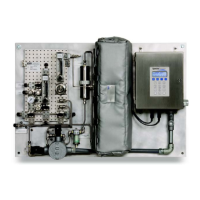
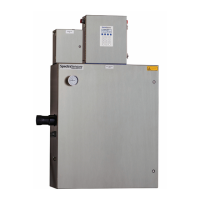
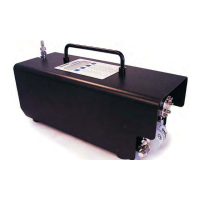
Each SS2000 is specifically configured for use at pipeline sampling stations,
refineries, plastics plants, or wherever accurate real-time measurements are
required over a wide measurement range. Depending on the particular
accessories and options ordered, the system may also include, for example, a
differential switching system that enables the sensor to compare the content
of the sample to a reference gas, and/or a heated enclosure for highest
sensitivity, and/or a purge system for purging flammable gasses ensuring safe
operation in hazardous environments, just to name a few.
How the Analyzer Works
The SS2000 analyzer employs tunable diode laser absorption spectroscopy
(TDLAS) to detect the presence of trace substances in process gases.
Absorption spectroscopy is a widely used technique for sensitive trace species
detection. Because the measurement is made in the volume of the gas, the
response is much faster, more accurate and significantly more reliable than
traditional surface-based sensors that are subject to surface contamination.
In its simplest form, a diode laser absorption spectrometer typically consists of
a sample cell with a mirror at one end and a mirror or window at the other
through which the laser beam can pass, as shown in Figure 1–1. The laser
beam enters the cell and reflects off the mirror(s) making one or more trips
through the sample gas and eventually exiting the cell where the remaining
beam energy is measured by a detector. With the SS2000 analyzer, sample gas
flows continuously through the sample cell ensuring that the sample is always
representative of the flow in the main pipe.


 To Next Page
 Loading...