SS2000 Operator’s Manual
H
2
S in Natural Gas 2–3
Mounting the Analyzer
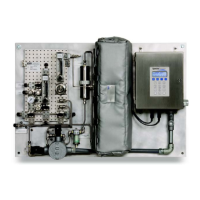
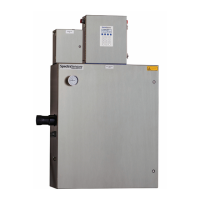
The SS2000 analyzer is manufactured for wall or Unistrut (or equivalent) metal
framing installations. Depending on your application and configuration, the
analyzer will come mounted on a plate or Unistrut frame. Refer to the layout
diagrams in Appendix B for detailed mounting dimensions.
To mount the analyzer:
1. Select a suitable location to mount the analyzer. Choose a shaded
area or use an optional analyzer hood (or equivalent) to minimize
sun exposure.
2. Locate the mounting holes on your unit.
3. For wall installations, mark the centers of the top mounting holes.
Mounting dimensions are shown in Figure B–1 on page B–2.
4. Drill the appropriate size holes for the screws you are using.
5. Hold the analyzer in place and fasten with the top screws.
6. Repeat for the bottom mounting holes.
Once all four screws are tightened the analyzer should be very secure and
ready for the electrical connections.
Connecting Electrical Power to the Analyzer
Depending on your configuration, your analyzer will be configured for
115/240 VAC @ 50/60 Hz 1∅ input, or optionally 9-16 VDC or 18-32 VDC
input. Check the manufacturing data label, the terminal block labels, or the
specifications (see Table B-1 on page B–1) to determine the power input
When mounting the analyzer, be sure not to position the
instrument so that it is difficult to operate adjacent devices. Allow
3 feet of room in front of the analyzer and any switches.
It is critical to mount the analyzer so that the inlet and outlet lines
reach the inlet and outlet connections on the chassis while still
maintaining flexibility so that the sample lines are not under
excessive stress.
SpectraSensors analyzers are designed for operation within the
specified temperature range of –4 °F to 122 °F (–20 °C to 50 °C).
Intense sun exposure in some areas may cause the analyzer
temperature to exceed the maximum.


 To Next Page
 Loading...