Time until final stop in target position (lower is better).
No slip on approach to the target position.
No oscillations around target position before stopping.
No spontaneous shifts from the target position after stopping.
Low noise when moving. Noise level is increased when only one of the PID coefficients is increased.
One can choose individual criterion priority depending on the task at hand when tuning PID regulator.
1. It is recommended to disable all DC motor limits including smooth acceleration/deceleration when you start tuning PID regulator.
2. It is recommended to tune PID regulator to maintain constant speed first.
3. It is recommended to start tuning PID regulator with integral and differential coefficients set to zero.
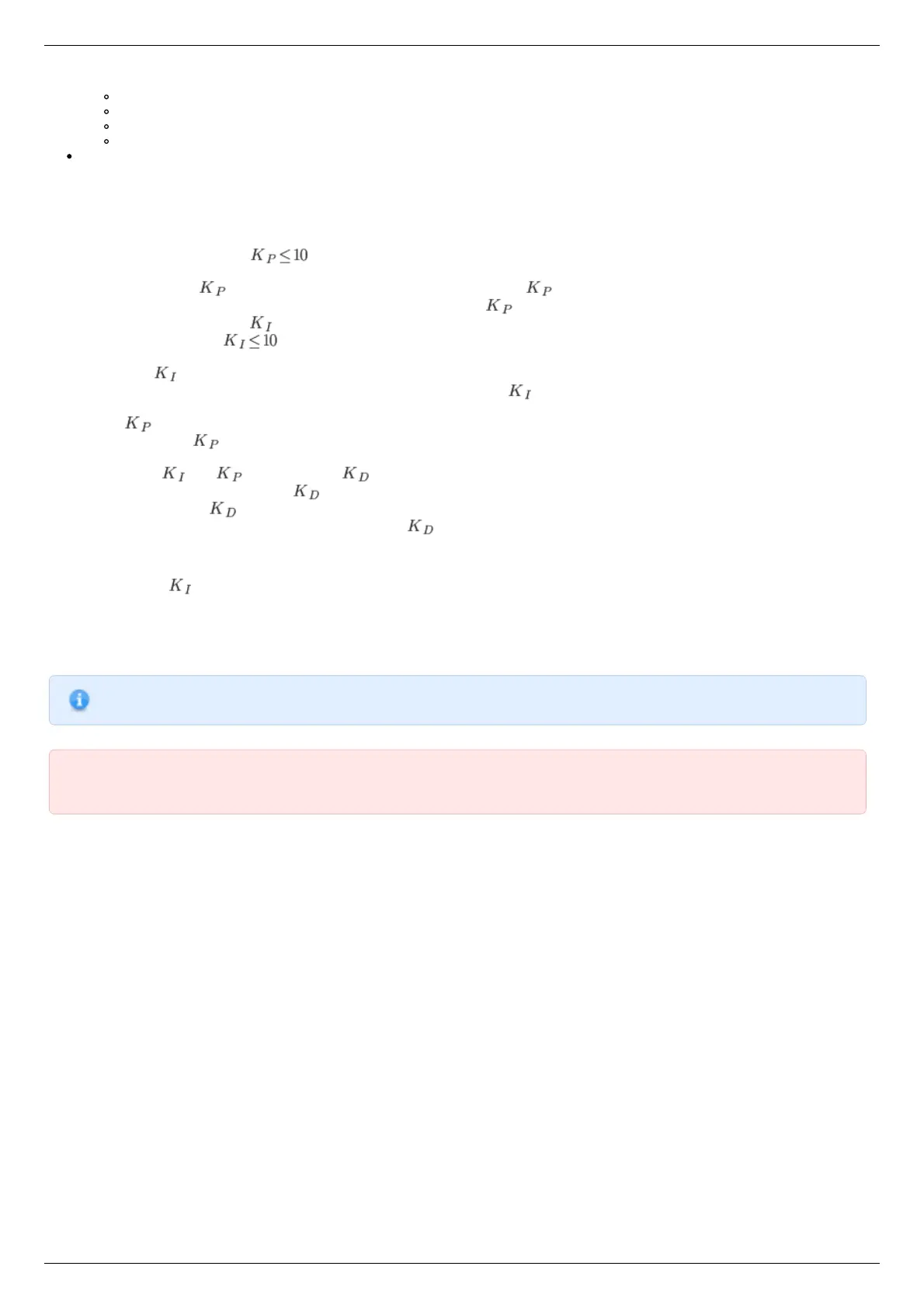
4. Set proportional coefficient
5. Set required movement speed and start the movement far away from the limit switches.
6. Gradually increase and observe current speed graph. Find optimal which makes the controller maintain current speed
the best and makes time to reach target speed less dependent on . One should be aware of possible noise level increase.
7. It is recommended to tune next. Integral PID regulator coefficient has more influence on position reaching behavior.
8. Set integral coefficient and start movement to position. It is convenient to use "shift on offset" command for this.
9. It is advisable to use sufficiently long shifts so that motor reaches at least 20% of required speed.
10. Increase of makes the controller stop at the target position faster.
11. Achieve faster reaching of the target position by gradually increasing . One should stop increasing this coefficient when either
quality of position reaching degrades substantially or noise levels increase. Slip at the target position will remain regardless.
12. Adjust up or down to decrease oscillations at the target position.
13. After one adjusts one should check the speed maintenance quality and noise levels. If these parameters are unsatisfactory
then one should adjust coefficients towards their previous values.
14. After setting and you can set up .
15. It is recommended to start tuning in speed maintenance mode and then check other quality parameters.
16. One should increase until speed oscillations around target speed stop decreasing.
17. In case of target position slip one should increase . However, further increases of this coefficent will lead to oscillations
around target position. One should keep a balance between oscillations and target position reaching speed.
Turn on smooth acceleration/deceleration if you plan on using this mode. This can lead to the slip at the target position. To compensate
one should increase .
After these steps the initial setup of PID algorithm is complete. The obtained coefficients are in most cases suitable for motor
operation. To further optimize these coefficients one can vary them while continuously monitoring quality according to the relevance of
chosen quality criterions to the particular task.
Note. It is not recommended to adjust more than one coefficient at a time while tuning the PID regulator.
IMPORTANT. It is extremely not recommended to start with large values of PID regulator coefficients or to rapidly
adjust them. This can lead to self-excitation of speed oscillations and motor failure.


 To Next Page