31
DRL3 Digital Receiver Line Card 3.
DTMF Dual Tone Multiple Frequency. A method of dialing which utilizes 2 sets of 4 tones (frequencies) each. Selecting
one tone from each set will produce 16 distinct pairs. These pairs are used to dial digits when dialing a telephone
number.
Ethernet A network protocol which encompasses the lowest logical layer of the network stack, immediately above the phys-
ical layer. This protocol is governed by the IEEE and is outlined in the IEEE802.3 specification. Ethernet consists of
several variations, including 10Base2, 10Base5, 10BaseT, 100BaseT, and others. 10BaseT and 100BaseT are the
most prevalent.
Equivalent
Line Number
An option in the receiver. By default printer and computer messages will contain the line card number. Sometimes
it is necessary to output the printer and computer messages with a different line card number; in this case this
option can be used to overwrite the line card number in the printer and computer outputs of the receiver.
Event The specific type of alarm being reported by the panel.
Event Code A term used to describe a character or group of characters in an automation output. This character(s) is used to
represent the event that was reported by the panel. Example 1: SG automation reports an alarm event using an
event code of 'A', Restore as 'R', or Trouble as 'T'. Example 2: Sur-Gard automation reports using a SIA output for a
burglary alarm an event code of 'BA'.
FES Format Expert Systems. The name given to a receiver task which performs the basic functions of: 1. sending hand-
shakes; 2. detecting the format from the panel; 3. processing the alarm from the panel; 4. sending a kiss-off to the
panel.
For mat The pre-established order of events and meanings of the various characters in an alarm transmitted from a panel to
a receiver.
FSK Frequency Shift Keying. A modulation technique used with low-speed modems (300 to 1800 bps). The carrier fre-
quency is shifted between two discrete frequencies in accordance with the binary serial data.
Handshake A signal sent by the receiver to a panel indicating that a connection has been established. These are either tones or
modem data.
Heartbeat A periodic signal sent from the automation outputter tasks to the automation software to verify the presence of
that output. The period of this heartbeat is controlled via an option in the CPM3. Alternatively, the heartbeat refers
to the signal sent between CPM3s to verify the presence/absence of each other.
Hook Flash The process of the receiver going temporarily off-hook, usually in an attempt to transfer the phone call.
Hot-Swap-
pable
Refers to the ability to add or remove particular cards to or from the system without removing power. In the Sys-
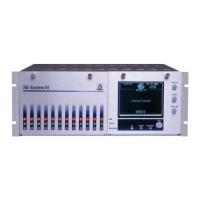
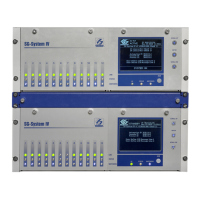
tem III, the CPM3, DRL3, DC/DC3 and PSC3 are all fully hot-swappable.
HTTP Hypertext Transfer Protocol. A higher level protocol within the TCP/IP suite of protocols which is responsible for
implementing web browsers. This is the protocol implemented by the CPM3 to enable the web interface to func-
tion.
IEEE 1284 See Centronics.
IEEE 802.3 See Ethernet.
Inter-burst
Time
A term for the reception of pulse formats. The time between two bursts.
Inter-digit
Time
A term used for reception of pulse or DTMF formats. The time between two digits.
Internal
Tro ubl e
A trouble condition which is generated inside a receiver, as opposed to being sent as an alarm from the panel.
Internal troubles are also sent to the printer and automation outputs.
Kiss-off A term used in the security industry for a positive acknowledgement.
Line An individual channel on a line card. Equivalent to 1 telephone line.
Line Card A removable, hot-swappable card which contains a POTS line interface which controls 1 or more POTS lines. For
System III, each line card (DRL3) will interface to 1 line.
Line Condi-
tioning
Electrical compensation for attenuation and phase delay distortion exhibited by the PSTN. Conditioning is per-
formed through the use of an equalizer.
MAC
Address
Media Access Control. A globally unique device 6-byte address which identifies a device attached to an Ethernet
network.
Assignment of MAC addresses is governed by the IEEE; any OEM company which manufactures Ethernet devices
must apply for and purchase an OUI (Organizationally Unique Identifier), which consists of a block of 16,777,216
MAC addresses, all of which have the same first 3 bytes. Subsequent allocation of addresses within that block is at
the discretion of the purchaser. Each Ethernet device produced must be programmed with a different MAC address
in order to guarantee that each device will function correctly on the network. For the System III, the MAC address is
stored in serial EEPROM on the CPM3 board. It is only programmable during manufacturing.


 To Next Page