6
1.4 Receiver Setup and Operation
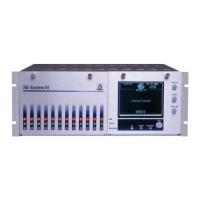
DSC recommends testing the receiver before actual
installation. Becoming familiar with the connections
and setup of the unit on the workbench will make
final installation more straightforward.
The following items are required:
• IEC power supply cord
•One telephone line
• One or more dialer or digital control panel(s)
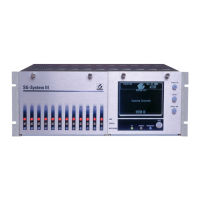
1. Unpack the components for the System III.
NOTE: Carefully unpack the receiver and inspect
for shipping damage. If there is any apparent dam-
age, notify the carrier immediately.
2.Unscrew the front thumb screws and open the
front plates.
NOTE: Before inserting the CPM3 connect the rib-
bon cable from the UIB3 board. Before inserting
the PSC3 connect the LCD backlight.
3. Insert all the cards in the rack, in their appropriate
position (refer to figure 1-2). Connect the ribbon
cable of the front panel to the CPM3 before insert-
ing it. Connect the backlight power connection to
the PSC3 then insert the PSC3.
4. Insert the PSU3 into the rack and fasten it properly.
5.Connect a telephone line to the proper line.
6. Connect the main power using a standard com-
puter IEC cable (not supplied).
7. The LCD will power up and display internal troubles
(printer, computer, telephone line fault). The DRL3
that has the telephone line connected to it will have
its red LED off. If the LED is always on make sure the
telephone line is connected to the right port.
NOTE: Internal diagnostics may require more than
one minute during the power up sequence.
8.Send a signal from a control panel to the receiver.
The signal will be displayed on the LCD. Press the
[ACK] button to silence the buzzer and clear the
signal from the LCD.
1.5 Description (Operation)
1.5.1 Operation with Default Programming
Without any changes to the factory default program-
ming, the receiver operates as indicated below:
• Answers incoming calls on the first ring
• Sends the following handshake order
• Receives all communication formats, except for 3/2,
3/1 checksum, SKFSK, 4/2 extended, and 4/2 check-
sum (see Option 95).
• The above formats can be manually selected
• Signals can be displayed on the debug output com-
puter as they are received. The signals are then sent
to the printer and computer connected to serial port
COM1 or to the 10/100BaseT connector. The default
event codes described in the DRL3 Library Decod-
ing and Event Codes Table will be used with the
Sur-Gard automation communication protocol to
send signals to the computer, if connected.
• If a computer is not connected press the [ACK]
button on the CPM3 to silence the buzzer and to
clear the alarm(s) from the LCD display.
1.5.2 Virtual Connectivity
Each receiver has one static IP address and a number
of associated ports. Internal socket programming
uses specific ports for expected tasks. The configura-
tion management, done from the Console Software,
is located on port 1024. The System III Console soft-
ware is provided for Windows 98/ME/NT/2000/XP,
which provides a graphical style menu for configura-
tion management. Additional features are available
with the Console software including storage of virtual
receiver setups and configuration wizards.
NOTE: For Windows NT, user must be logged in as
Administrator or with administrator rights for
proper use of the Console Software.
1.5.3 Status Addressing
Line card status is reported via physical addressing.
Shelf and slot number are assigned automatically to
each line card. All device status information is in Sur-
Gard format. The reporting of status on this port,
automation output and printer will relate to physical
addressing.
1.5.4 Automation Input/Output (Port 1025)
Traditional automation communication is provided
via port 1025 on the Ethernet connection. This pri-
mary port is a Sur-Gard standard output and pro-
vides Sur-Gard standard automation output.
1.5.5 Compatibility
Central station automation software packages such as:
• MAS • DICE • SIMS II • GENESYS
• S.I.S. • IBS • MicroKey
support the System III Sur-Gard interface. Refer to
automation software specifications for compatibility.
NOTE: Automation connections are considered sup-
plementary per UL864 Listing. Compatibility with the
automation software in a system used at a central
station is intended to be handled under a separate
UL1981 software and/or site certification evaluation.
1.5.6 Automation Protocols
The System III receiver sends a variety of protocols
to report signals to the central station computer via a
TCP/IP and/or RS-232 port. A complete list of proto-
cols can be provided upon request.
1.5.7 Data Byte Protocol
The System III receiver uses a default configuration of
9600 Baud rate, 1-start bit, 8-data bits, 0-parity bits
and 1-stop bit structure, to transmit and receive signals
1
2
3
4
5
6
2300 Hz
1400 Hz
Dual-tone
SIA FSK
ITI, Modem IIE/IIIa2
Modem II


 To Next Page