30
Glossary
Account The portion of a signal which contains the information identifying the location or the owner of the alarm panel. Also
referred to as account number, account code or account digits.
Acknowl-
edgement
(ACK)
A signal sent from the receiver to the panel indicating that data has been received. A positive acknowledgement
(ACK) means data was received without any detected errors. (see kiss-off). A negative acknowledgement (NAK)
means data was received, but there were detected errors. An acknowledgement may be sent per packet or per
alarm.
AHS Automatic Handshake Selection. Refers to the receiver feature which enables the line card to request the hand-
shake to be used with a particular panel from the CPM. The CPM maintains a database of most recently used
handshakes for all accounts connected to the receiver. Handshakes are stored along with the phone number of the
associated alarm panel.
Alarm A message transmitted from the panel to the receiver containing account, event, zone, user or other information.
There may be one or more per call. An alarm may be repeated in the same call (if not successfully delivered in a
previous attempt). An alarm will contain one or more packets. Packets can contain rounds or different information.
Alarm transmission is initiated with a handshake and, if received correctly, acknowledged with a kiss-off.
ANI Automatic Number Identification.
ASCII America Standard Code for Informational Interchange. A seven-bit alphanumeric code used extensively in data
communications. Parity is often added to the seven-bit code for error detection.
AutomationThe combination of software package and PC which connects to the receiver to receive alarm events.
The automation can be connected either by direct serial connection or TCP.
Automation
Message
The alarm information delivered by a receiver in a specified protocol to a central station computer or network. Also
referred to as a computer message
Backplane See BP3.
Block A group of data that specifically makes up one of the elements of an alarm. For example: account block, event
block, or alarm block. One packet could contain multiple blocks.
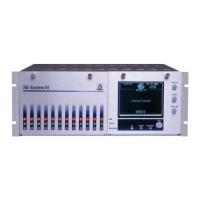
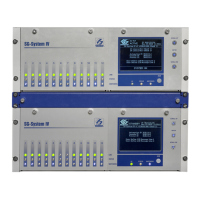
BP3 A motherboard-style PCB which acts as the backbone for a single shelf of a System III receiver. The BP3 contains
sockets to which up to 12 DRL3s, 1 CPM3, 1 PSC3 and 2 DC/DC3s can be connected. Furthermore, 2 BP3s can be
connected together to form a 2-shelf configuration for the System III receiver. The BP3 also contains connections
for a parallel printer and 2 serial automation COM ports, as well as an Ethernet connection. Also referred to as a
backplane.
Busy Out A state of a line card. Under predefined criteria the line card will go off-hook so as to not process any new alarms.
Call The process of a receiver going off-hook, receiving one or more alarms and returning on-hook.
Caller ID An FSK format received by the line card. This format can be received prior to sending the handshakes. The Caller ID
data can be used by the receiver to provide additional information to all alarms received during a call.
Capture The ability of a receiver to store commands sent to the panel from the automation computer after all of the alarms
have been sent from the panel to the receiver.
Centronics A parallel printer interface standard. Also known as standard IEEE1284. A centronics interface is implemented on
the CPM3 (through the backplane) to interface to the local parallel printer.
Checksum Additional data added to an alarm indicating whether the contents have been received correctly. This is generally
done by summing all the digits in the message (mod 256) and reporting this as the checksum. Different methods
of calculating a checksum may be specified in particular formats or protocols.
C.L.A.S.S Custom Local Area Signaling Services. This term is used in the telephone industry to represent all features of a
telephone line, such as Caller -ID, Call Forwarding, 3-Way Calling etc.
Client One side of a two-sided TCP socket connection. The client is the one responsible for initiating the socket connec-
tion with the remote host (the server). The console represents the client side of the socket connection with the
CPM3.
Computer
Message
See Automation Message.
Console A PC application program which can connect to the receiver and provide diagnostic/programming abilities to the
user. For the System III, the console connects to the CPM3 via TCP/IP.
CPM3 Central Processing Module 3. The CPM3 controls the overall operation of the System III receiver, which includes
multiplexing alarm signals from the line cards and sending them to the appropriate outputs
DC/DC3 The DC power supply of the System III receiver.
Dialer Another name for a control panel.
DNIS Dialed Number Identification Service.


 To Next Page