Glossary
11
Negative Acknowl-
edgement (NAK)
See acknowledgement.
Off-Hook The process of connecting to the telephone line to answer an incoming call or dial a remote device (answering).
On-Hook The process of releasing the telephone line after completion of a call (hanging up).
Options A set of user-configurable parameters which controls the operation of a device. In the System III, both the DRL3
and the CPM3 contain sets of options. Static options are affect all Profiles on a card. Dynamic options are
unique to each profile.
Packet A group of digits or characters of information in an alarm.
Panel A device (the alarm system) at the protected premises used to transmit alarms to the receiver.
Ping A standard network command which can be used to verify the presence of a device on a network, using the
device IP address. Ping is implemented as part of the ICMP protocol and consists of the Echo Request and Echo
Reply commands (poll and response respectively).
POTS Plain Old Telephone System. An acronym used to describe a standard analog telephone network, or alterna-
tively a standard analog telephone line.
Printer Message The alarm information delivered by a receiver to a central station printer. This information is generally encapsu-
lated in a descriptive English text message.
Profile Generally refers to a group of options. The receiver can select a "profile" based on certain conditions.
Protocol The pre-established order of events and meanings of the various characters in the information transmitted from
a receiver to a monitoring computer.
PSC3 Power Supply Controller 3.
PSTN Public Switched Telephone Network. Analogous to POTS.
PSU3 Power Supply Unit 3.
Receiver The equipment used to receive alarms sent from panels. Sur-Gard's receivers are the SLR and the MLR. 'Receiver'
is sometimes used interchangeably with 'line card' as it is the line card which actually receives the alarm in the
MLR.
Ring One of the wires used on a phone line, by convention this is red.
Rounds Two or more packets of alarm information used for error checking. If two packets (rounds) are identical the
packet contains valid data.
RRLLL The part of the automation message which stores the receiver number and line card number. The length of this
field is variable and is controlled via an option in both the line card and the CPM3.
Server One side of a two-sided TCP socket connection. The server is the one responsible for receiving the socket con-
nection with the remote host (the client). In general, a host which acts as a server can receive multiple client
socket connection requests simultaneously. The CPM3 acts as a server to both the console and the web inter-
face.
SG Sur-Gard, a brand name of DSC. Also used to describe a particular type of automation output.
SIA Security Industry Association. Sometimes referred to as the SIA format which is an example of FSK modulation.
RS-232 An asynchronous, point-to-point serial communications protocol. Used to communicate between the DRL3 and
a PC for the DRL3's debug output. Also used to communicate between the CPM3 and the automation computer,
and the CPM3 and a PC for the CPM3's debug output.
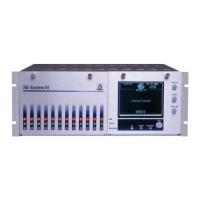
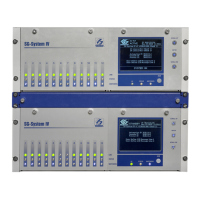
System III Name given to a single entire receiver configuration, including rack, CPM3(s), line card(s), power supply, etc.
TCP/IP Transmission Control Protocol/Internet Protocol. A standard network communications protocol. On the Sys-
tem III, TCP/IP is used to communicate between the console and the CPM3. It is also used to connect the CPM3
to a TCP printer (resident on the console) and TCP automation software (runs independent of the console).
Tip One of the wires used on a phone line, by convention this is green.
UIB3 User Interface Board 3. An L-shaped board which connects to the CPM3 and contains output LEDs and 4 push
buttons used for the user interface. This board also connects directly to the LCD screen.
Zone The portion of an alarm which contains the information identifying the specific zone of the panel that has been
violated.


 To Next Page