
 Need help?
Do you have a question about the Synology DS1511+ and is the answer not in the manual?
Overview of hardware components and specifications for 1-bay and 2-bay models.
Overview of hardware components and specifications for 4-bay models.
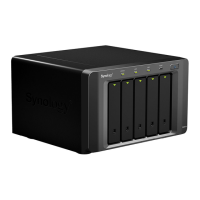
Overview of hardware components and specifications for 5-bay models.
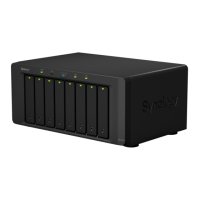
Overview of hardware components and specifications for 10-bay models.
Instructions for installing the Synology DiskStation operating system.
Steps to access the DiskStation Manager interface via web browser or assistant.
Description of the DSM desktop, taskbar, and icons.
Guide to navigating and using the DSM Main Menu for applications and settings.
How to customize user account settings like password and description.
Customize DSM login style, HTTP service options, and session security.
Configure IP address, DNS, gateway, LAN, Bond, and wireless network settings.
Set display language, email language, and codepage for file names.
Manage HDD hibernation, power recovery, and fan speed settings.
Explanation of storage concepts like volumes, disk groups, and RAID types.
Creating, setting up, and managing storage volumes and disk groups.
Setting up and managing iSCSI targets for network storage access.
Creating and managing iSCSI Logical Unit Numbers (LUNs).
Enabling write cache, running S.M.A.R.T. analysis, and checking disk info.
Connecting, formatting, and ejecting external USB or eSATA disks.
Simplified setup for internet access via a wizard.
Configuring router port forwarding for external access.
Registering a dynamic DNS hostname for internet accessibility.
Creating firewall rules to control network access and prevent unauthorized logins.
Enabling auto block to prevent brute-force attacks by blocking IPs with failed logins.
Supporting file sharing protocols for Windows, Mac, and Linux.
Configuring the DiskStation as a Windows file server (CIFS).
Configuring the DiskStation as a Mac file server (AFP).
Enabling NFS service for access by Linux clients.
Adding the DiskStation to a Windows ADS domain or workgroup.
Creating and managing user and group accounts for access control.
Step-by-step guide to creating and editing user accounts.
Enforcing password policies for enhanced security.
Enabling personal folders for users to store their data.
Creating and managing user groups for easier administration.
Controlling which applications users can access.
Creating and managing shared folders for data storage and sharing.
Setting specific access permissions for shared folders using Windows ACL.
Methods for accessing shared folders from Windows, Mac, and Linux within the intranet.
Using FTP to access shared folders remotely.
Utilizing the web-based File Browser for file management.
Performing searches within shared folders using various criteria.
Performing file operations like download, upload, copy, move, rename, delete.
Modifying access privileges for individual files and subfolders.
Backing up data from computers to the Synology DiskStation.
Methods for backing up DiskStation data locally, over network, or to Amazon S3.
Synchronizing shared folder data between different DiskStations.
Utilizing the Time Backup feature for versioned backups.
Copying data from USB devices to DiskStation using the Copy button.
Copying data from SD cards to DiskStation using the Copy button.
Setting up the DiskStation to host websites using Web Station.
Configuring the DiskStation to function as a mail server.
Using the DiskStation to share printers on the local network.
Connecting computers to the DiskStation's print server.
Enabling the Photo Station service for DSM admin.
Allowing DiskStation users to have their own Personal Photo Station.
Creating, updating, and deleting Photo Station user accounts.
Uploading new albums to shared folders using various methods.
Managing albums via upload, delete, download, reorder, and editing details.
Customizing album layout and photo thumbnail settings.
Enabling the Audio Station service to play music from DiskStation.
Selecting music sources like library, personal/shared playlists, iPod, or media servers.
Browsing music, changing views, and searching for music files.
Viewing and editing metadata for music files.
Creating, managing, and editing personal and shared playlists.
Playing music using the queue panel and music player.
Enabling and performing music downloads from Audio Station.
Enabling the Download Station service for file downloads.
Configuring settings for BitTorrent, HTTP, FTP, and NZB downloads.
Setting download schedules and alternative speeds for download tasks.
Creating download tasks by uploading files or entering URLs.
Searching for torrent files using integrated search engines.
Creating download tasks from RSS feeds.
Managing created download tasks like pausing, resuming, removing, or editing.
Configuring settings for eMule downloads, including server and connection options.
Connecting to ED2K servers to search and download resources.
Creating download tasks for eMule via file upload or URL entry.
Managing eMule download tasks, including pausing, resuming, editing, and clearing.
Enabling the Surveillance Station service for IP camera management.
Adding, editing, and testing IP camera configurations.
Configuring camera settings, recording schedules, and motion detection.
Exporting and importing camera settings for backup or transfer.
Viewing real-time video feeds from configured IP cameras.
Customizing the display layout for live camera views.
Controlling camera pan, tilt, and zoom functions.
Utilizing digital zoom, volume control, presets, and patrol functions.
Browsing, playing, downloading, and deleting recorded events.
Searching for events based on specific criteria like motion or object detection.
Adjusting image brightness, contrast, saturation, and sharpness for event playback.
Exporting recorded events to shared folders or external storage devices.
Mounting exported event archives for playback in Event Management or Timeline.
Creating and managing E-Maps to visualize camera locations and links.
Setting up email or SMS notifications for important events.
Configuring initial page settings, centralized management, and VisualStation.
Assigning privileges to users for Surveillance Station functions.
Managing camera licenses for using Surveillance Station with IP cameras.
Managing VisualStation devices to view camera feeds on TV or LCD monitors.
Enabling DLNA/UPnP media server to stream multimedia content.
Improving compatibility with DMA devices by enabling transcoders or MIME types.
Enabling iTunes service to share music and videos with iTunes clients.
Creating and editing smart playlists for music organization.
Viewing DiskStation's general information, network, storage, and logs.
Monitoring CPU usage, memory usage, and network flow.
Checking for and installing the latest DiskStation Manager (DSM) updates.
Installing, upgrading, uninstalling, and managing software packages.
Setting up email or SMS notifications for important system events.
Restoring the DiskStation to its factory default settings.
Reinstalling the Synology DiskStation system without losing data.
Enabling SNMP service for network monitoring.
Enabling Telnet or SSH for system login and management.
Using Synology apps like DS audio, DS cam, DS photo+, and DS file on mobile devices.
Accessing DiskStation features using other mobile devices via web browser.
Detailed specifications for 1-bay DiskStation models.
Detailed specifications for 2-bay DiskStation models.
Detailed specifications for 4-bay DiskStation models.
Detailed specifications for 5-bay DiskStation models.
Detailed specifications for 10-bay DiskStation models.
Notes on limitations of certain features like USB printers and file systems.
Table detailing LED indicators for 1-bay models.
Table detailing LED indicators for 2-bay models.
Table detailing LED indicators for 4-bay models.
Table detailing LED indicators for RackStation models.
Table detailing LED indicators for 5-bay models.
Table detailing LED indicators for 10-bay models.
 General
| CPU Architecture | x86 |
|---|---|
| Drive Bays | 5 |
| Maximum Internal Raw Capacity | 15TB (5 x 3TB HDD) |
| External Ports | 4 x USB 2.0, 2 x eSATA |
| Hot Swappable HDD | Yes |
| Dimensions | 157mm x 248mm x 233mm |
| RAM | 1GB DDR2 |
| LAN Ports | 2 x Gigabit Ethernet |
| RAID Support | RAID 0, RAID 1, RAID 5, RAID 6, JBOD |
| Operating System | DiskStation Manager (DSM) |
| CPU | Intel Atom D525 |


 To Next Page
