V1.1-OCTOBER 2019
| 2
OMNIA MPX NODE MANUAL
1. Coding artifacts produced by stereo codecs require additional processing (post
transport) to correct overshoots and other errors prior to stereo generation.
2. Artifacts occurring in μMPX coding manifest as FM noise and go unnoticed.
With μMPX, lower bandwidth IP connections and narrow band STL channels can now be
used to transport MPX signals. μMPX will create new audio distribution options and cut
equipment needs and costs, as it leverages advances in the world’s ever-growing IP infra-
structure. Sound quality also benefits as this purpose-built codec makes its way into more
places. As with all new groundbreaking technologies, potential applications for μMPX
will only grow as creative radio engineers begin utilizing it. Watch for μMPX to make its
way into an increasing number of Omnia products.
A Distinction from L/ R signals
An important concept for all readers to understand is that MPX Node transports modulat-
ed FM signals, not L/R audio. This modulated signal contains the components that make
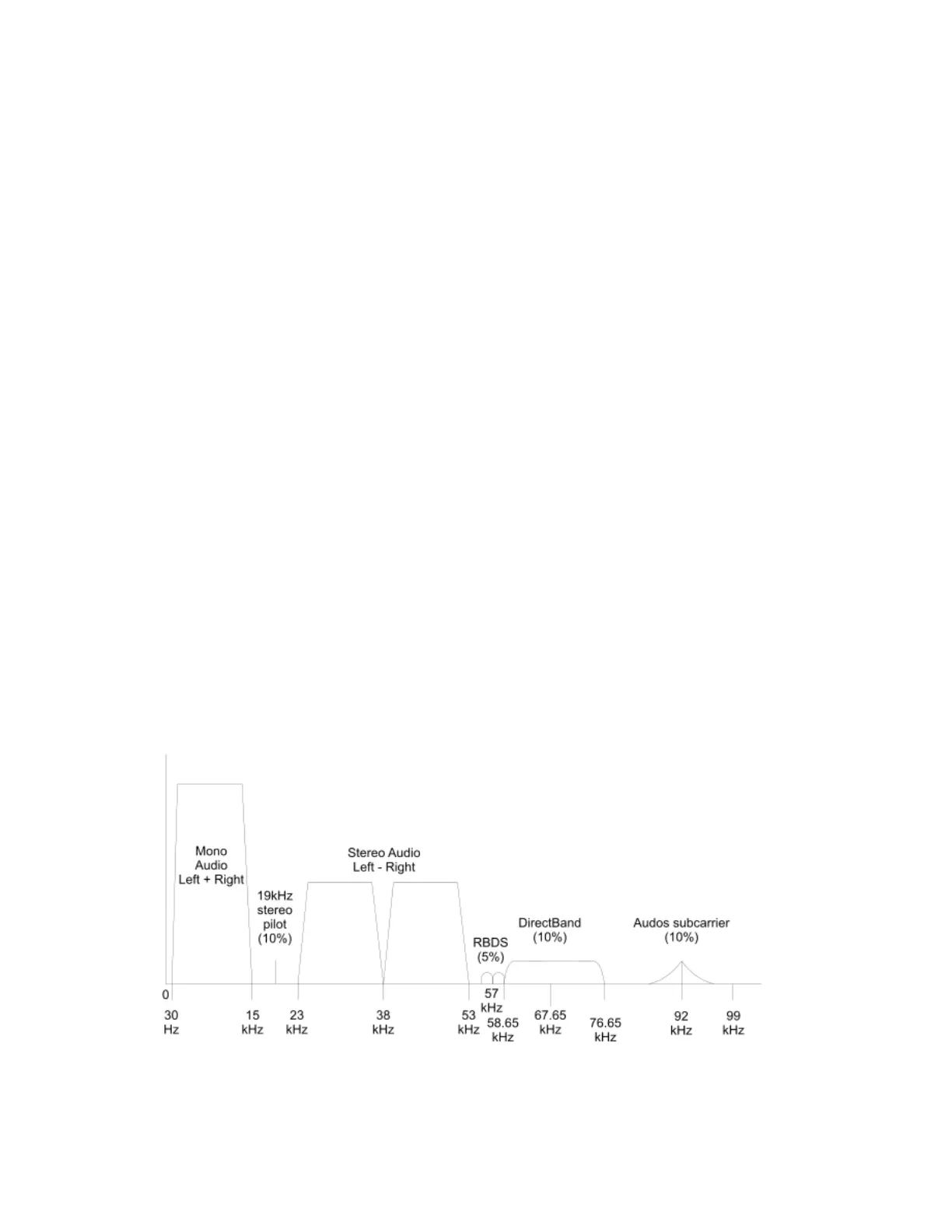
up an FM broadcast; L+R, 19kHz stereo pilot, L-R and RDS/RBDS at the first subcarrier.
As an encoder, MPX Node converts composite analog FM to IP packets; as a decoder, it
converts packets to analog composite FM. As such, the Encoder version needs to be fed by
the output of an audio processor, while the decoder is intended to feed the analog compos-
ite input of an FM transmitter. In some ways, MPX Node may be thought of as a modem
for FM signals. For reference, a diagram of FM signal is useful.


 To Next Page