16
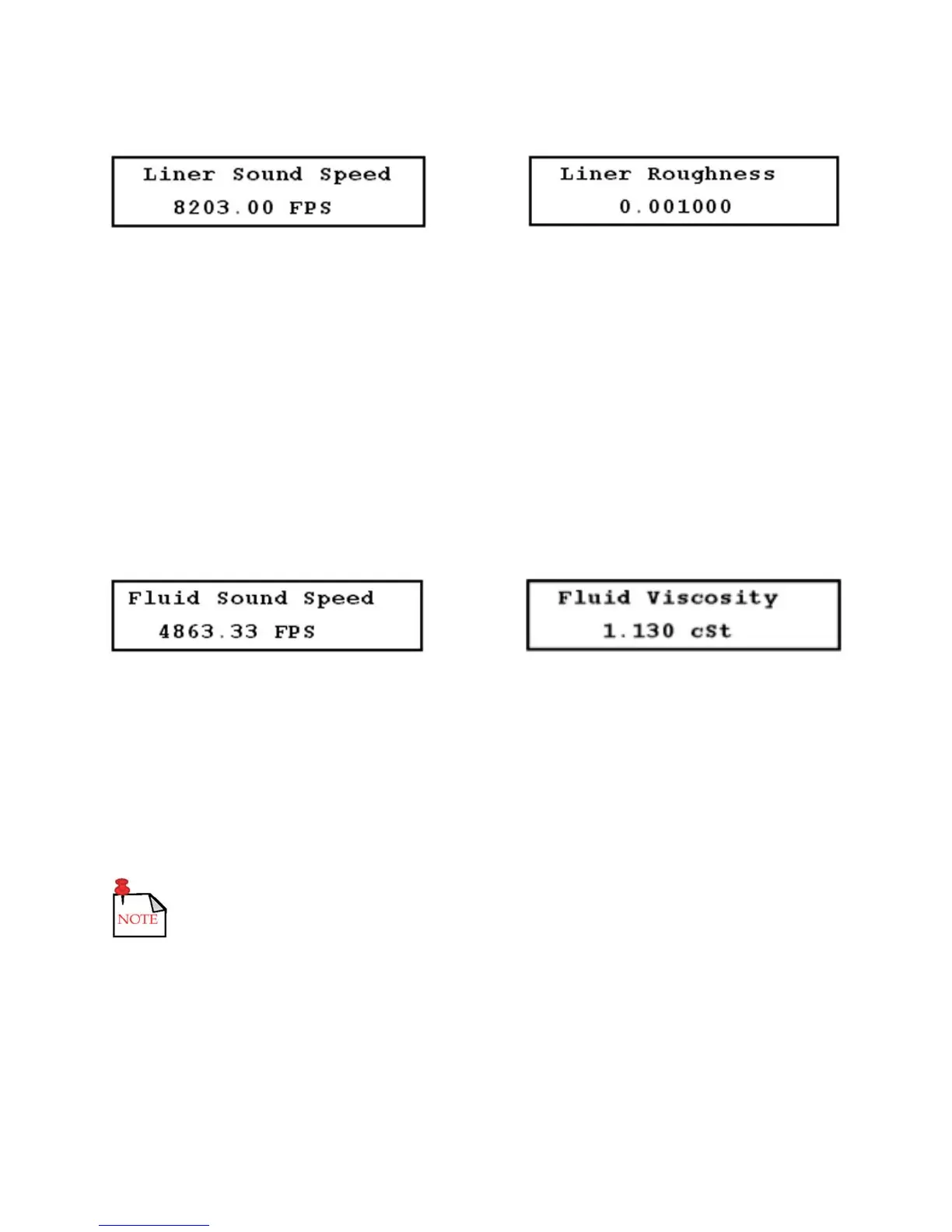
.....Additional setup menus within the LINER submenu
FIGURES 3.8-A (LEFT) & 3.8-B (RIGHT)
3.9 Additional Setup Menus Within the FLUID Submenu
*Not included in the Quick Setup configuration
1. Fluid Sound Speed setup menu (21): This menu can only be configured if you selected OTHER as the
fluid type in Menu 20. Enter the fluid sound speed. If you did not select OTHER as the fluid type, this
menu is available by the direct access method only and functions as a view-only display to indicate the
fluid sound speed as programmed in the flowmeter’s database (Figure 3.9-A, below).
2. Fluid Viscosity setup menu (22): This menu can only be configured if you selected OTHER as the fluid
type in Menu 20. Enter the fluid viscosity. If you did not select OTHER as the fluid type, this menu is
available by the direct access method only and functions as a view-only display to indicate the fluid
viscosity as programmed in the flowmeter’s database (Figure 3.9-B, below).
FIGURES 3.9-A (LEFT) & 3.9-B (RIGHT)
3.10 Additional Setup Menus Within the FLOW Submenu
*Not included in the Quick Setup configuration
1. Max Flow Range setup menu (31) and Min Flow Range setup menus (32): Use these menus to enter
the minimum and maximum flow values for setting the volumetric flow range. Setting the optimum flow
range generally improves the flowmeter’s response time (Figures 3.10-A and 3.10-B, page 17).
Whenever the pipe ID is changed, the flowmeter returns the volumetric flow range
to its default settings. The default settings are the minimum and maximum flows
for the new pipe ID that occur at +32 and -32 ft/s (+9.76 and -9.76 m/s).
2. Damping setup menu (33): Use this menu to enter the value for the damping coefficient, which
suppresses short-term fluctuations in the indicated flow rate. The displayed flow rate and the 4-20 mA
current loop output is a moving average of the last n seconds where n is the damping value.
Increasing the coefficient increases the response time to changes. The coefficient is adjustable from 1
to 99 seconds in 1-second increments. Keep damping at a minimum unless the flow rate fluctuates
wildly. If this is the case, increase the damping coefficient justenough to reduce the fluctuation to an
acceptable degree (Figure 3.10-C, page 17).



 To Next Page