1
1. PRODUCT OVERVIEW
1.1 Introduction
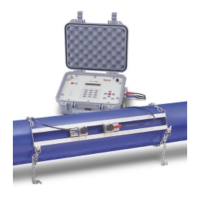
The DCT7088 Digital Correlation Transit Time Flowmeter is a microprocessor-based instrument which
measures the flow of clean, homogeneous liquids (liquids without large concentrations of suspended
particles or gasses such as air bubbles). The flowmeter is noninvasive, which means that it measures flow
from outside the pipe. Its transducers can be mounted to a pipe within a matter of minutes, and flow
measurements may be made without interrupting the flow or modifying pipe work.
The DCT7088 can be configured using an integral keypad for entering variables such as pipe size, pipe
material, wall thickness, and fluid type (refer to Section 3, page 8). The flowmeter can also be remotely
configured and monitored via the RS232 interface mode using the D-Link data link utility (refer to Appendix
C, page 69). Another alternative to flowmeter configuration is to use the UltraScan utility which also
graphically analyzes the signal in a Microsoft
®
Windows
®
environment (UltraScan manual provided on
PolyCD).
1.2 Theory of Operation
Sound waves travel in fluids at a specific velocity depending on the type of fluid. If the fluid is moving, the
sound wave travels at a velocity equal to the sum of the speed of sound in the fluid and the velocity of the
fluid itself relative to the transducer. A sound wave traveling in the same direction as the fluid flow (down-
stream) will arrive sooner than a sound wave traveling against the flow (upstream). A transit time flowmeter
operates by measuring both the absolute travel time of each sound wave and the difference in time
required for the waves to travel between an externally mounted downstream and upstream transducer
(Figure 1.2-A, below). Based on the transit time of the 2 sound waves, the flowmeter calculates the
average fluid velocity.
FIGURE 1.2-A: TYPICAL TRANSIT TIME SYSTEM
Once the differential transit time is calculated, several additional variables must be taken into consider-
ation. The overall velocity of the fluid is actually made up of many individual local velocities that vary
according to their distance from the pipe wall. The velocities in the center of the pipe are higher than the
velocities near the pipe wall. The combination of these individual velocities for a specific type of fluid within
a specific pipe yield a velocity distribution known as the flow profile (Figure 1.2-B, page 2), which is a
function of the Reynolds number. By properly configuring the flowmeter, the effects of the flow profile are
taken into consideration when calculating the mean fluid velocity. The flowmeter then multiplies this
velocity by the pipe’s cross-sectional area to obtain volumetric flow.



 To Next Page