Cooling System
Maintenance
Cooling System Safety
• Swallowing engine coolant can cause poisoning;
keep out of reach from children and pets.
• Discharge of hot, pressurized coolant or touching
a hot radiator and surrounding parts can cause
severe burns.
– Always allow the engine to cool at least 15
minutes before removing the radiator cap.
– Use a rag when opening the radiator cap, and
open the cap slowly to allow steam to escape.
• Do not operate the machine without the covers
in place.
• Keep your ngers, hands and clothing clear of
rotating fan and drive belt.
• Shut of f the engine and remove the key before
performing maintenance.
Checking the
Engine-Coolant Level
Service Interval : Before each use or daily —Check
the level of the coolant.
Cooling-system capacity: 3.7 L (4 US qt)
Coolant type: a 50/50 solution of water and
permanent ethylene-glycol antifreeze
W ARNING
If the engine has been running, the
pressurized, hot coolant can escape and
cause burns.
• Do not open or add coolant to the radiator;
doing so introduces air into the system
and results in engine damage. Add only
engine coolant to the reservoir .
• Do not open the radiator cap when the
engine is running.
• Use a rag when opening the radiator cap,
and open the cap slowly to allow steam to
escape.
1. Park the machine on a level surface.
2. Shift the transmission lever to the P (P ARK )
position.
3. Shut of f the engine and remove the key .
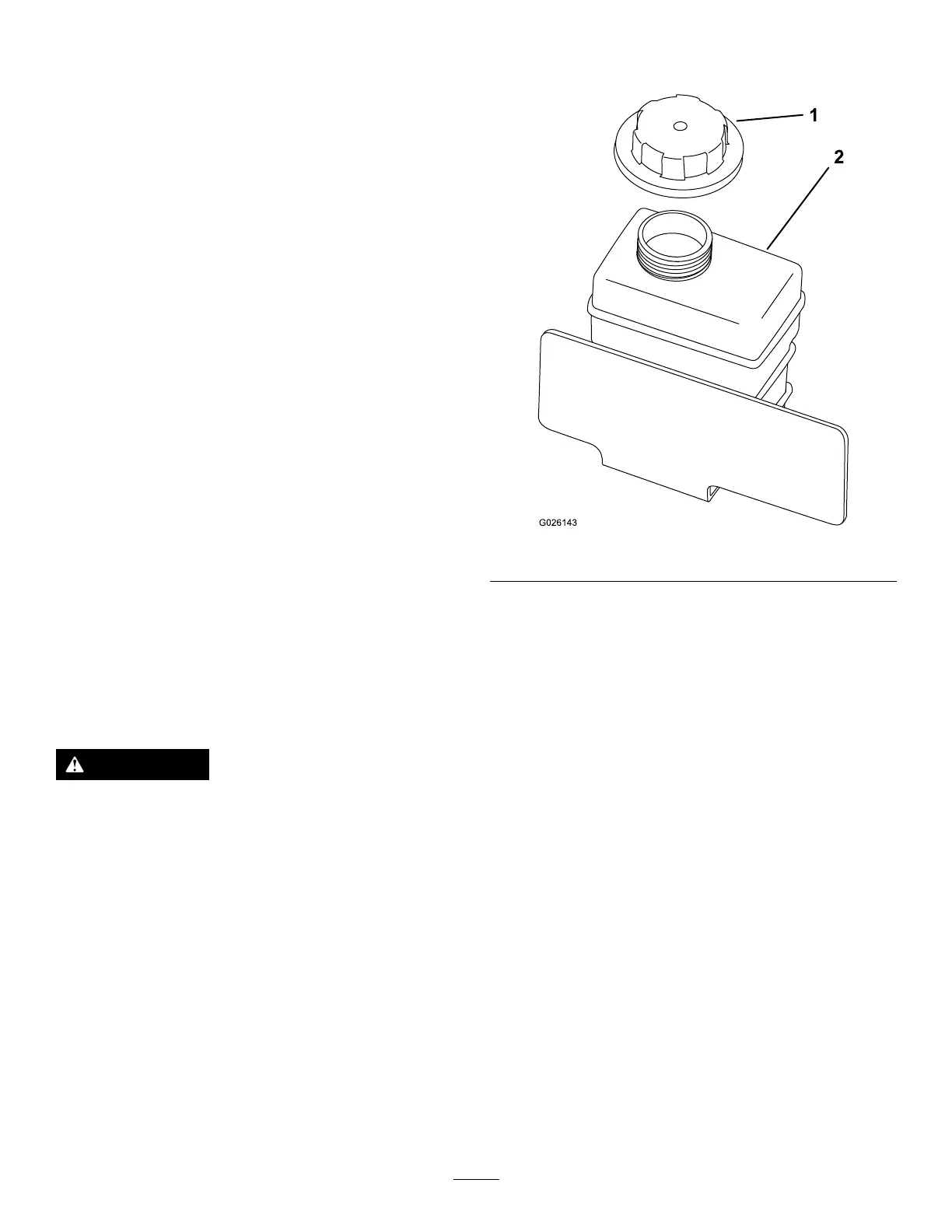
4. Check the coolant level inside the reserve tank.
g026143
Figure 51
Note: The coolant should be up to the bottom
of the ller neck when the engine is cold.
5. If coolant is low , remove the coolant-tank cap
and add a 50% ethylene-glycol with organic
additive technology (OA T) 50% distiller water
antifreeze.
Do not overll.
6. Hand-tighten the reserve-tank cap.
51




 To Next Page