Technical Specifications
Standards
IEEE 802.3
IEEE 802.3u
IEEE 802.11a
IEEE 802.11b
IEEE 802.11g
IEEE 802.11n (up to 300 Mbps)
IEEE 802.11ac (up to 433 Mbps)
Hardware Interface
1 x 10/100 Mbps port
Router/AP-WISP/off switch
WPS button
Reset button
LED indicators
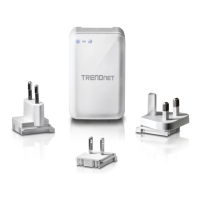
Interchangeable power plugs: US, EU, UK
Modes
Router
Repeater
WISP*
Features
Compact form factor
IPv6
Dual band connectivity
Multiple SSID
Multicast to Unicast converter
WDS
VPN passthrough support
Access Control
Wireless encryption: up to WPA2
Firewall: NAT, ALG, Port Trigger, Virtual Server, Special Applications, DMZ Host,
PPTP/L2TP/IPsec VPN Passthrough
Wireless guest networks
Parental (Access) Controls: Website filter
Inbound filter
Quality of Service
Bandwidth control
WMM
Frequency
5 GHz: FCC: 5.180 – 5.240 + 5.745 – 5.825; ETSI: 5.180 – 5.725 GHz
2.4 GHz: FCC: 2.412 – 2.472; ETSI: 2.412 – 2.472 GHz
Modulation
802.11b: CCK, DQPSK, DBPSK
802.11a/g/n: BPSK, QPSK, 16 QAM, 64 QAM sub carrier with OFDM
802.11ac: BPSK, QPSK, 16 QAM, 64 QAM, 256 QAM with OFDM
Antenna Gain
5 GHz: 3 dBi (max.) internal
2.4 GHz: 2 dBi (max.) internal
Wireless Output Power/Receiving Sensitivity
802.11a: FCC: 20 dBm, CE: 18 dBm (max.)/-65 dBm (typical) @ 54 Mbps
802.11b: FCC: 20 dBm, CE: 16.5 dBm (max.)/-83 dBm (typical) @ 11 Mbps
802.11g: FCC: 20 dBm, CE: 16.5 dBm (max.)/-65 dBm (typical) @ 54 Mbps
802.11n (2.4 GHz): FCC: 17 dBm, CE: 13.5 dBm (max.)/-61 dBm (typical) @ 300
Mbps
802.11n (5 GHz): FCC: 18 dBm, CE: 18 dBm (max.)/-61 dBm (typical) @ 150
Mbps
802.11ac: FCC: 14 dBm, CE: 14 dBm (max.)/-51 dBm (typical) @ 433 Mbps


 To Next Page