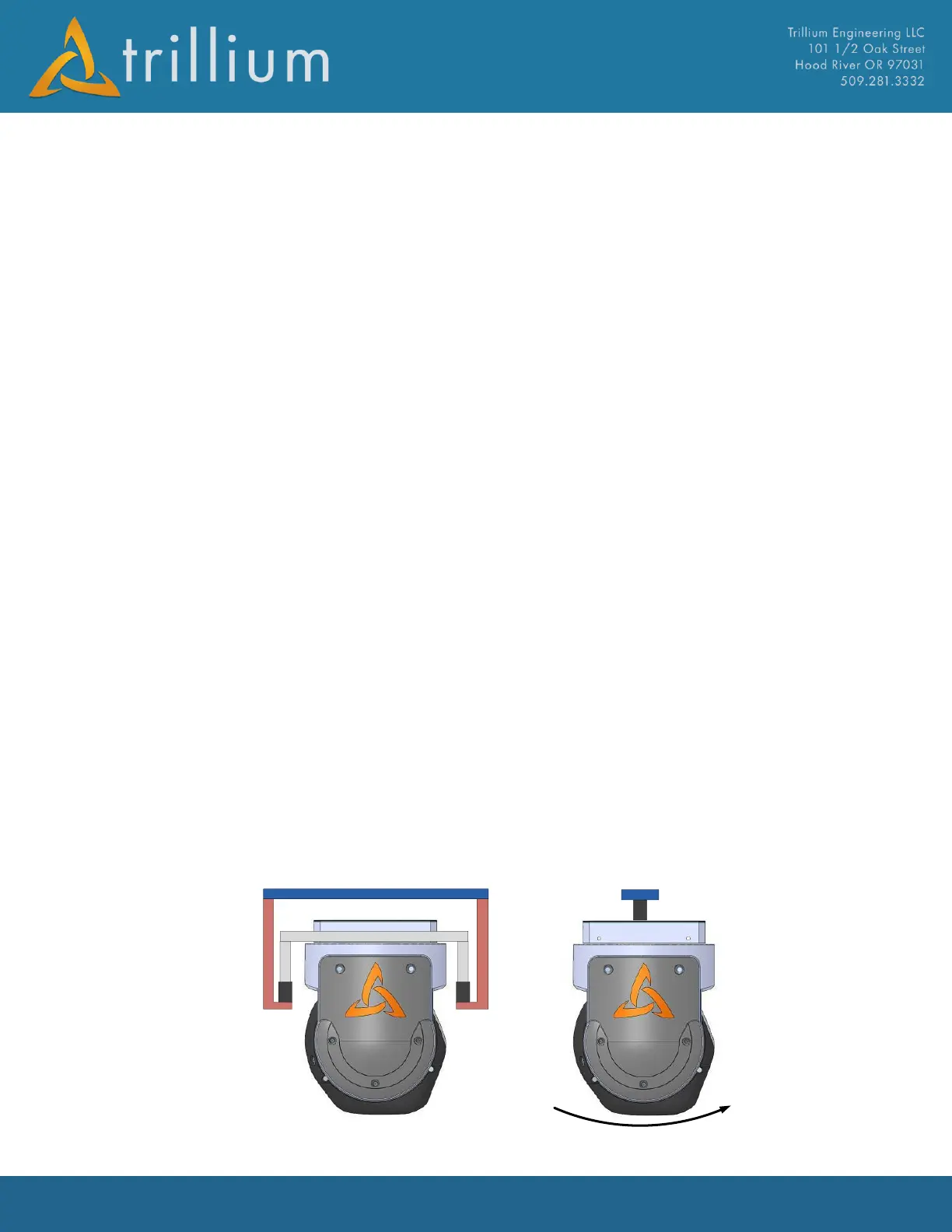
approaches nadir which is located at a tilt angle of 90 degrees; therefore, each orientation has its
own advantages:
• Pan over tilt provides a 360-degree field of regard and is an intuitive to control, but doesn’t
allow the gimbal to look directly below the aircraft.
• Roll over tilt allows the gimbal to look directly below the aircraft and has optimal stability
while viewing a target in an orbit since the tilt angle is nominally zero in this orientation.
However, the gimbal cannot provide a 360 degree field of regard and the video orientation
changes, requiring roll compensation for human operators to effectively control the gimbal.
Generally a pan over tilt orientation is used unless the mechanical integration constraints drive the
design towards a roll over tilt orientation.
10.1.2 Vibration Isolation
Integrating an effective vibration isolation scheme is of utmost importance and often overlooked –
make sure to follow the guidelines below to obtain the best imagery from the aircraft. Trillium
gimbals are able to inertially stabilize with a closed loop bandwidth of 60Hz; inputs above this
frequency such as engine vibration cannot be eliminated and may result in video blur. Including a
well-designed vibration isolation system will attenuate these high frequency inputs and increase
image quality on every platform. The following rules of thumb should be followed when integrating
vibration isolators:
• Isolators should be located at the gimbal center of gravity. Isolators located above the
gimbal result in a pendulum effect where the gimbal has a low frequency sway that can
reduce image quality.
• The spacing between the isolators should be maximized; softer isolators can be used without
a gimbal induced resonance if the space between the isolators is increased.
• The isolated weight should be maximized. Vibration isolation is far more effective with
larger masses, so the optimal approach is to hard mount the gimbal to a large plate that
hosts batteries or other components with mass, then isolating that larger assembly.
• All brackets should be stiff with a natural frequency of at least 100Hz to avoid structural
resonances


 To Next Page