ATOMIC STRUCTURE
A more detailed discussion of radiological theory can be found in the
Troxler Nuclear Gauge Safety Training Program manual, provided at the
Troxler safety class.
All materials consist of chemical elements that can not decompose by
ordinary chemical methods. Some examples are:
(H) Hydrogen (C) Carbon (O) Oxygen
(U) Uranium (Cf) Californium (Co) Cobalt
The fundamental component of an element is an atom with a unique
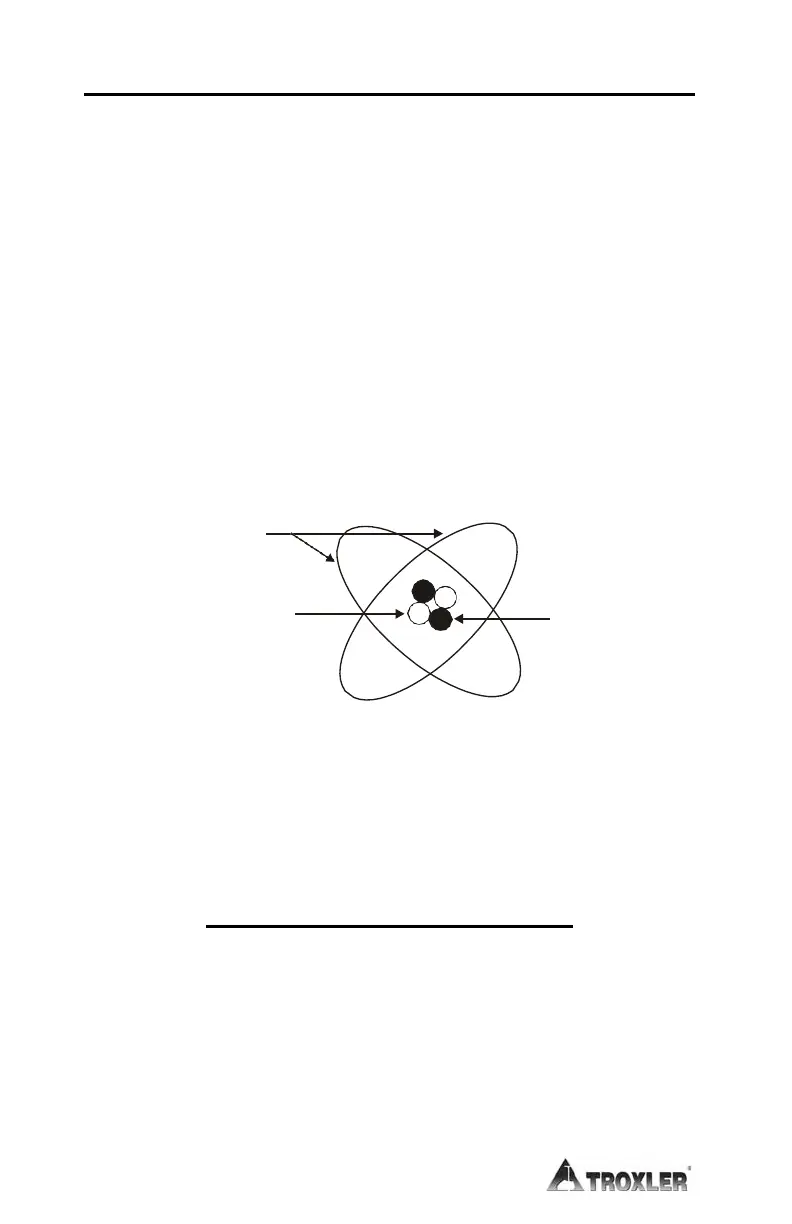
structure (Figure B–1). The atom consists of smaller particles such as
protons, neutrons, and electrons. The protons and neutrons are grouped
together in the nucleus. The electrons orbit the nucleus. An atom is
normally electrically neutral because the positive charges of the protons
cancel out the negative charges of the electrons.
ELECTRONS
NEUTRON
PROTON
Figure B–1. Diagram of an Atom
Protons carry a positive charge and are described as having a mass of one.
Neutrons have a neutral charge and also have a mass of one. Electrons
carry a negative charge and essentially have no mass.
MASS
(ATOMIC WEIGHT SCALE)
CHARGE
Protons 1.0073 +1
Neutrons 1.0087 0
Electrons 0.0006 1
Since protons and neutrons are clustered together in the nucleus, the mass
of an atom is concentrated in the nucleus. The atom in Figure B–1 has two
protons and two neutrons; therefore, it is a helium atom. The atomic weight
of an atom is the sum of the protons and neutrons.





 To Next Page